

Firdous Qadri
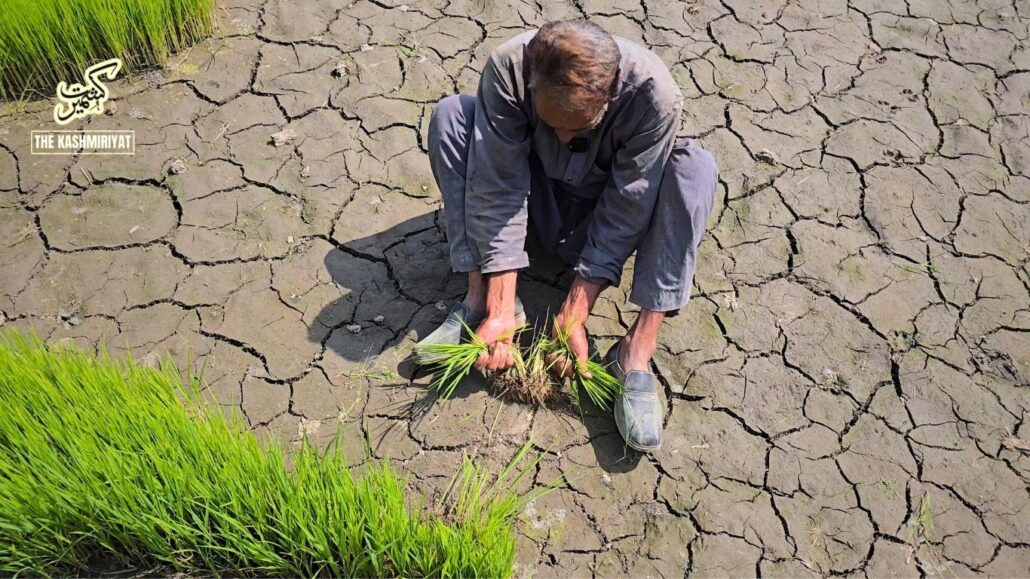
In the Check Dhara belt of Harwan, where paddy once glistened under Kashmir’s midsummer sun, the land today lies cracked and thirsty. The familiar rhythm of water flowing through the gullies is gone. What remains is silence, heat, and the anxious footsteps of farmers chasing what little water they can find.
“We are helpless,” said Bashir Ahmad Reshi, a farmer with rough palms and a weary gaze. “The deadline has passed, and we are still waiting for water.” He referred to June 21—the customary end of the paddy transplantation season in Kashmir. This year, that date came and went like a taunt.
Reshi, like many in his village, told The Kashmiriyat that the fields had gone dry earlier than ever. The mountain springs—lifelines for irrigation—began to retreat weeks ago, robbed by an unusually hot summer and the premature melting of snow in the upper reaches. What nature once gave steadily, it now delivers in short, erratic bursts.
Just beyond his field, Abdul Rashid Ganie dragged a rusted spade through the sunbaked soil, carving desperate trenches toward a small pool of stagnant water. “We are trying everything,” he said, his breath shallow from the heat. “But this land does not respond to hope alone. It needs water.”
Across Check Dhara, the worry is the same. Cracks have replaced puddles. Crops planted with prayer now wilt under a punishing sky.
Locals say this crisis didn’t arrive alone—it was accompanied by silence from those meant to respond. “We have called, pleaded, but the irrigation department hasn’t shown up,” a group of men near a shrine said. “Every hour we lose is a season lost.”
Environmentalists have long warned that the Valley’s water systems—heavily reliant on glacial melt and snow-fed streams—are vulnerable to climate shifts. But for the farmers in Harwan, these warnings are now lived realities. They are not climate models or policy briefs. They are dry hands, broken routines, and rice grains that may never sprout. “We don’t want compensation in future,” said Reshi, his voice low. “We want water now.”

- News Deskhttps://thekashmiriyat.co.uk/author/kashmiriyat/

- News Deskhttps://thekashmiriyat.co.uk/author/kashmiriyat/

- News Deskhttps://thekashmiriyat.co.uk/author/kashmiriyat/
- News Deskhttps://thekashmiriyat.co.uk/author/kashmiriyat/

