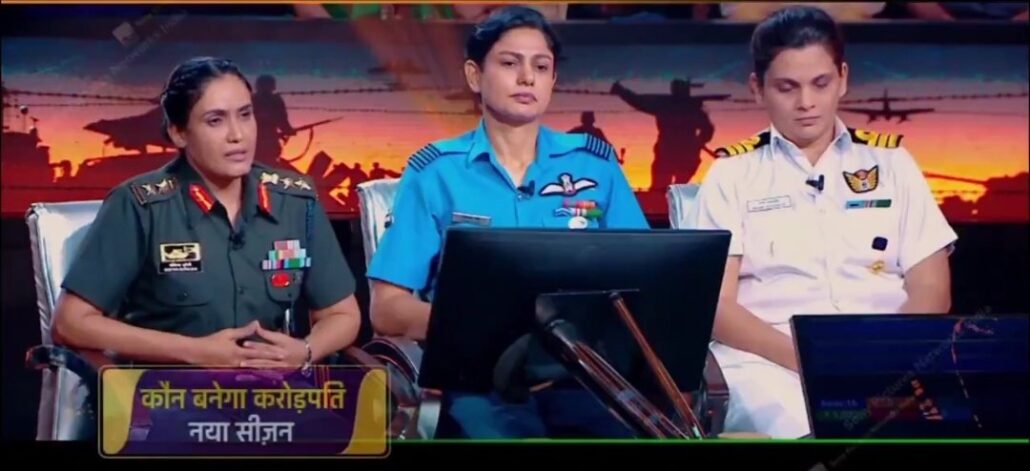
A special Independence Day episode of Kaun Banega Crorepati (KBC) has stirred controversy after it announced the appearance of three serving women officers, Colonel Sofiya Qureshi, Wing Commander Vyomika Singh, and Commander Prerna Deosthalee.
Colonel Qureshi and Wing Commander Singh were the public face of Operation Sindoor, a cross-border strike on Pakistan-based camps carried out in retaliation for the April 22 Pahalgam attack. Both officers fronted high-profile media briefings in the days following the operation, becoming symbols of the military’s assertive stance.
Commander Deosthalee made history last year by becoming the first woman to command an Indian Navy warship.
In a promo clip released by the channel, Colonel Qureshi is seen explaining to host Amitabh Bachchan why Operation Sindoor was necessary. The teaser, quickly shared across social media, triggered an intense debate.
Some social media users welcomed the tribute, with one post reading, “Proud to see our women in uniform being celebrated on a national platform.” But others questioned the intent, pointing to what they saw as the politicisation of the armed forces.
“Our Army was sacrosanct, above politics, beyond PR. Today, the Modi government parades serving soldiers on shows like KBC for image building. Even our Army has been made a political tool for Modi’s PR. Our forces are to defend the nation, not a politician’s brand,” wrote X user Mayank Saxena.
Priyanka Chaturvedi of Shiv Sena remarked, “Our heroic women in uniform who went on to become the face of Operation Sindoor have been invited by a private entertainment channel on their show. This private entertainment channel’s parent company, Sony Pictures Networks India (SPNI), has also bagged the broadcasting rights of the Asia Cup till 2031.” She added pointedly, “Yes, the very channel that seeks to earn revenue through India vs Pakistan cricket matches. Now join the dots.”
One post read, “First they send them to the border, then they parade them on TV for TRPs and elections.” Another critic commented, “Our soldiers are not PR tools. Let their bravery speak for itself.”
A more scathing observation captured the sentiment of many sceptics: “We have been selling pain, emotions, tragedy, lynching, and communal hatred for ages. Have we now become a nation that even sells nationalism for profit?”
The controversy has exposed a deeper divide between those who see such appearances as inspirational moments for the youth and those who believe the boundary between honouring the armed forces and using them for political or commercial gain is being dangerously eroded.
For critics, the episode is yet another example of how nationalism has been commodified, packaged, and sold in modern India’s media landscape, where the lines between genuine tribute, political branding, and entertainment revenue have become increasingly blurred.
For supporters, however, it remains a moment of pride, showcasing the bravery and achievements of women officers on one of India’s most-watched platforms.

- News Deskhttps://thekashmiriyat.co.uk/author/kashmiriyat/

- News Deskhttps://thekashmiriyat.co.uk/author/kashmiriyat/

- News Deskhttps://thekashmiriyat.co.uk/author/kashmiriyat/
- News Deskhttps://thekashmiriyat.co.uk/author/kashmiriyat/
