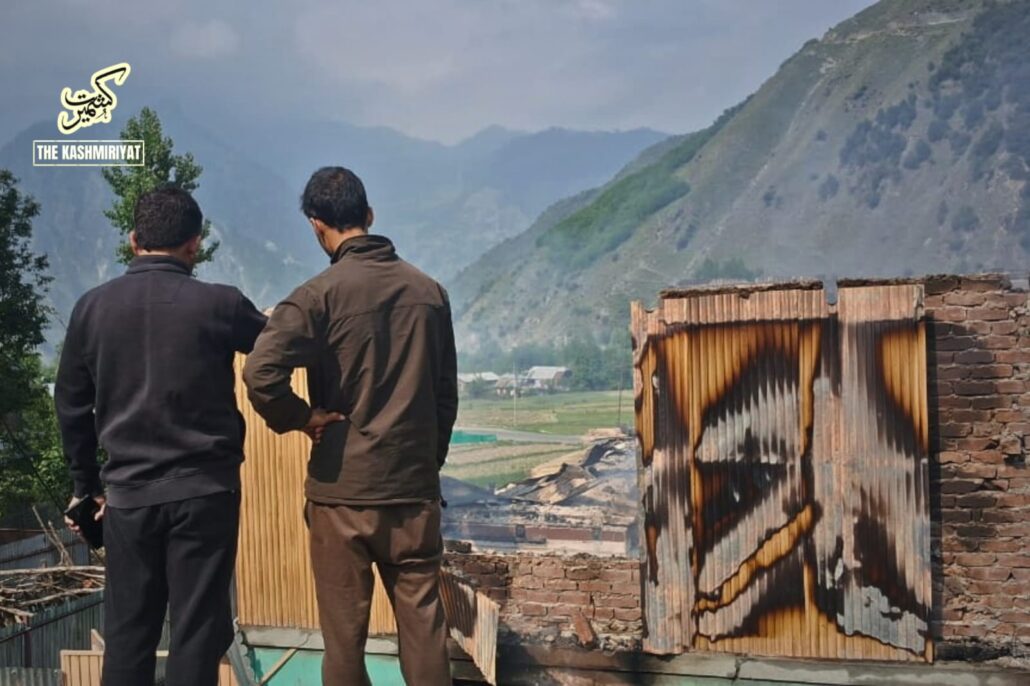
The sustained ceasefire along the Line of Control (LoC) has opened up previously inaccessible stretches of the border in Jammu and Kashmir to political outreach. Leaders across the political spectrum are now visiting villages long battered by cross-border shelling and drone strikes, meeting affected families, and demanding relief, adequate compensation, and improved security infrastructure for civilians living in these vulnerable areas.
In the Surankote sector of Jammu’s Poonch district, Bharatiya Janata Party (BJP) state president Sat Sharma led a delegation to meet families mourning the deaths of twin children, Zoya and Ayan, who were killed in the Chaktru sector. “After the Pahalgam massacre, Prime Minister Modi promised retribution. That promise has been fulfilled. Now, we must ensure the safety and rehabilitation of our citizens,” Sharma said. He reiterated that talks with Pakistan are not an option until cross-border terrorism ends. “The people in these border areas are not merely asking for compensation—they are demanding recognition, protection, and dignity,” he added.
The BJP delegation included senior leaders Dr. Devinder Kumar Manyal, Vibodh Gupta, and Dr. Shehnaz Ganai. They assured residents that both the Union and UT governments are committed to swift rehabilitation and lasting security solutions.
In the neighboring border belts of Rajouri and Poonch, former deputy chief minister Tara Chand toured relief camps and conflict-hit villages such as Danna Chapri, Sajwal, and Kot Mehra. He demanded ₹5 lakh in compensation and 10-marla residential plots for every family displaced by shelling. “The displaced are living without basic facilities, and relief is being distributed selectively. It’s time the administration moved beyond temporary measures,” he said. He also called for the construction of community bunkers and support for border farmers who lost livestock and crops.
From the opposition, People’s Conference (PC) president Sajjad Gani Lone visited Tangdhar in north Kashmir’s Kupwara district. He criticized the current compensation mechanism as outdated and inadequate. “Labeling homes as ‘half-damaged’ or ‘fully damaged’ trivializes losses that run into crores,” Lone remarked. “These were war-like situations, not personal disputes. It’s disgraceful to offer crumbs in the name of compensation.” He advocated for a new damage assessment model involving both the Roads and Buildings Department and the Revenue Department. He also argued for individual household bunkers, stating, “If we can build houses under PMAY, why can’t we sanction bunkers for those living under constant threat?”
Lone made a passionate appeal against the glorification of war. “I have never seen a war produce anything definitive. It only leaves behind destruction and grief,” he said.
Meanwhile, in Poonch, senior Congress leader and JKPCC president Tariq Hameed Karra conducted a day-long visit to shelling-affected villages, including Bandichechian. He met grieving families, including that of Qari Mohammad Iqbal, and condemned national media reports that falsely labeled one of the victims as a terrorist. “This is not just a smear on the deceased—it’s psychological violence against the family. Legal action must be taken,” Karra demanded.
He also criticized Prime Minister Narendra Modi for failing to mention Poonch in his recent speech. “This region has suffered tremendously. The least the Prime Minister could do is acknowledge it,” Karra said. He called for a special relief package and an all-party meeting. “From the Pahalgam massacre to the foreign-brokered ceasefire—there are significant developments that require cross-party deliberation,” he added.
As the border remains calm for now, a collective message is emerging from all political quarters: the need for compensation that matches the scale of loss, infrastructure that ensures safety, and a ceasefire that endures—not just on paper, but in spirit.

- News Deskhttps://thekashmiriyat.co.uk/author/kashmiriyat/
- News Deskhttps://thekashmiriyat.co.uk/author/kashmiriyat/
- News Deskhttps://thekashmiriyat.co.uk/author/kashmiriyat/
- News Deskhttps://thekashmiriyat.co.uk/author/kashmiriyat/


