Bhat Yasir
One of the most enduring and chilling anecdotes from Kashmir’s Afghan period revolves around a man named Chirag Beigh. Though his historical existence remains disputed, the legend surrounding him offers a powerful metaphor for the terror that characterized Afghan governance in the region. According to oral tradition in Kashmir, when Beigh was appointed as governor and brought from Kabul by Kashmiri nobles in a bid to secure better governance after the decline of the Mughal order, he encountered a funeral procession on his entry into Srinagar. Without a trace of empathy, Beigh is said to have stopped the mourners, pulled off the corpse’s shroud, and sliced off the dead man’s ears. He declared, “Not only the living but also the dead should know that Chirag Beigh is coming to Kashmir.”
ALSO READ: Under Dogra rule, Kashmiri Muslims paid a tax to marry—’Zar-e-Nikah’ explained
This grotesque act became so ingrained in local consciousness that the phrase “Wothya Chirag Beigh” (literally, “Here came Chirag Beigh”) is still used in rural speech to mock carelessness or describe senseless damage. While prominent Kashmiri historian Mohammad Ishaq Khan has warned against treating every folk account as literal fact, he noted in his writings on Kashmiri memory that the symbolic power of such stories reflects deep psychological scars from foreign rule.
Walter R. Lawrence notes that as the Mughal grip loosened, Kashmir fell into disarray. “As the Mughal empire began to decay, the subahs in Kashmir became independent and high-handed… Kalashpura, a Hindu ward of the city, was set on fire and the Hindus were forbidden to wear turbans.” By 1751, Subahs had become virtually independent of Delhi, setting the stage for a foreign takeover. “Then the unfortunate valley passed into the hands of new masters,” Lawrence writes, “and Kashmir became subject to the Pathan rule, the cruellest and worst of all.”
Afghan rule in Kashmir formally began in 1752, when Ahmad Shah Abdali (Durrani), the founder of the Durrani Empire, invaded Kashmir following the collapse of Mughal authority. The Mughal administration had weakened after Aurangzeb’s death (1707) and further deteriorated due to Afghan incursions and internal instability. After a power struggle among local elites and external actors, Abdali’s general, Abdullah Khan Ishik Aqasi, was appointed the first Afghan governor of Kashmir. His entry into the Valley marked the beginning of a 67-year rule, lasting until 1819, when the Sikhs under Maharaja Ranjit Singh defeated the Afghan garrison and annexed Kashmir.
Though technically under Kabul’s control, Kashmir was governed by a succession of 36 Afghan governors, most of whom were military men with little interest in local welfare or administration. The Afghan state extracted heavy taxes, demanded forced labor (begaer), and was known for its reliance on physical punishments to maintain control. The most frequently cited method of punishment, mentioned in both oral histories and colonial-era accounts such as Walter Lawrence’s The Valley of Kashmir (1895), was blinding, often carried out using hot iron rods.
This brutality wasn’t limited to criminals or rebels. It became a tool of administration, applied for tax defaults, minor disobedience, and even suspicions of dissent. The Afghan era is also remembered for the widespread confiscation of grain, cattle, and land. Traditional village heads (muqaddams) were often punished if tax quotas weren’t met, sometimes by public floggings or mutilation.

Power, Violence, and the Reshaping of Society
The memory of Afghan rule has remained so potent in Kashmiri folklore that it is often invoked even today when referring to brutal authority. Terms like “Pathan raj” (Afghan rule) are used colloquially as shorthand for injustice or lawlessness. This intergenerational memory suggests that the trauma of the era left a lasting imprint far beyond its chronological limits.
The administrative character of Afghan governance also differed sharply from that of the Mughals, whose decline paved the way for Ahmad Shah Abdali’s invasion. While the Mughals had relied on a relatively stable bureaucracy and patronage of local elites to maintain influence, the Afghans ruled as conquerors. They dismantled existing administrative linkages and replaced them with short-term governors whose primary loyalty was to the Durrani court rather than the welfare of Kashmir.
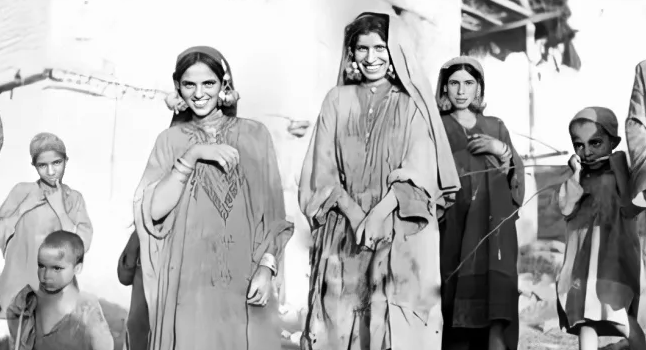
In addition to the forced labor (begar) and extortionate taxes, another hallmark of this period was the conscription of Kashmiri youth into Afghan military campaigns outside the Valley. Many families reportedly attempted to evade this by hiding their sons in forested hamlets or marrying off daughters at unusually young ages, fearing the retribution of Afghan officers. Accounts suggest that Kashmiri women smeared mud and coal on their faces to escape the attention of Afghani soldiers.
P.N.K. Bamzai records the horror that greeted the Afghan entry: “Rude was the shock that the Kashmiris got when they witnessed the first acts of barbarity at the hands of their new masters… Abdullah Khan Ishk Aqasi let loose a reign of terror… his soldiers set themselves to amassing riches by the foulest means possible.”
“Those who had the audacity to complain or to resist were quickly dispatched with the sword,” Bamzai continues. In a particularly gruesome instance, a Muslim noble named Jalil was tortured with red-hot iron bars. Another noble, Qazi Khan, was forced to pay a crippling fine, and when his son’s compliance was doubted, the young man was tortured until he drowned himself in the river.
Shia Muslims bore the brunt of sectarian hostility during this era. Though both the Afghans and the majority of Kashmiri Muslims were Sunni, the state-sanctioned attacks on the Shia community, especially in neighborhoods like Zadibal and Hasanabad, were often carried out under the pretext of quelling sedition or religious deviance. The Tarikh-i-Hassan details several such instances, including the 1801 attacks during Muharram processions, where Shia mourners were reportedly beaten and mosques desecrated.
One of the most brutal episodes of this period was under the governorship of Haji Karim Dad Khan, who according to Mohibbul Hasan “inflicted terror upon the masses with such regularity that rebellion was not merely punished, but anticipated.” His regime was marked by arbitrary floggings, executions, and widespread confiscation of grain, particularly during harsh winters when famines loomed.
Meanwhile, cultural and literary output shrank dramatically. Unlike the Mughal period, which saw patronage of Persian literature and calligraphy, Afghan rulers showed little interest in Kashmir’s artistic traditions. Libraries were neglected, and madrasas, except those aligned with orthodox Sunni lines, suffered from neglect or active suppression. Poets of the time like Mahmud Gami, though surviving the Afghan period, wrote in tones of despair and loss, often alluding to an atmosphere of “strangulation and dread.”
English traveller George Forster, who spent time in Kashmir during the Afghan period, wrote that “during my residence in Kashmir, I often witnessed the harsh treatment which the common people received at the hands of their masters, who rarely issued an order without a blow from the side of their hatchet… (The) extreme rigour has sensibly affected the deportment and manners of Kashmirians who shrink with dread from the Afghan oppression.”

Social Resistance and Folkloric Memory
The Afghan occupation of Kashmir, spanning nearly seven decades (1753–1819), left behind not just administrative changes and physical scars, but deeply embedded cultural memories; stories and spatial adaptations that continue to shape Kashmiri identity. In a time when organized rebellion was nearly impossible, resistance took on subtler forms. The Kashmiri response to the Afghan yoke unfolded in the muted language of architecture, oral storytelling, and familial caution, spaces where fear and defiance coexisted.
One of the most enduring motifs from this period is the tale of low doorways. According to widely circulated oral traditions, Afghan horsemen, contemptuous of Kashmiri subjects and arrogant in their bearing, often refused to dismount while entering homes, considering it beneath their pride to bow their heads or walk on foot. These sudden intrusions, particularly in outlying hamlets and the elevated alleys of Srinagar, became a source of dread.
Beyond the architecture, the Afghan period is etched into Kashmiri memory through narratives of trauma. Stories of forced intermarriages between Afghan soldiers and Kashmiri women survive not as verified events but as warning tales, narrated across generations. Such unions, far from acts of love, are remembered as desperate attempts by families to survive, offering daughters to powerful officials in the hope of avoiding looting, punishment, or dispossession. These stories, whispered rather than written, speak to the moral and emotional price Kashmiris paid under occupation, and to the survival instincts honed in a time of pervasive fear.
The collective memory also retains horrific accounts of punishments and cruelty. Tales of Pandits drowned in sacks in the Dal Lake, of Shias buried alive, of nobles tortured with red-hot iron, and of merchants forced to surrender their last coins under threat of mutilation, form the dark folklore of Afghan rule. These stories, drawn from historical accounts and enriched by communal narration, have passed into Kashmiri language and idiom as metaphors for oppression. Words like “Afghan zulm” (Afghan tyranny) or “Pathan chhu yen zulum” (That’s as cruel as a Pathan) remain part of Kashmiri parlance, not merely as references to history, but as living symbols of cruelty itself.
Yet not all resistance was symbolic. One of the less discussed but striking aspects of Afghan governance was its deeply extractive revenue system. As documented in Gulshan-i-Dastur, the administration devised an unusually intricate economic mechanism to standardize the value of rice, the staple crop, based on monthly fluctuations in supply. Since the cost of paddy would typically be low during harvest and rise sharply during months of scarcity, a month-wise commutation rate per kharwar (a unit of grain) was institutionalized.
This economic instrument was not merely technical; it reveals how intimately the regime sought to control and anticipate the material life of its subjects. The rates, ranging from 480 dams per kharwar in the first month to 44 dams in the eleventh and twelfth months, display an attempt at sophisticated regulation. But in effect, they reflected a regime acutely conscious of scarcity, hunger, and hoarding. That the Afghan administration prioritized such monthly calibration suggests that scarcity was not an exception but a recurring condition, perhaps exacerbated by the same systemic plunder that filled the governor’s coffers. For the Kashmiri peasant, every fluctuation in this chart was not an abstract fiscal concern but a negotiation with hunger.
In the first month, the rate for a kharwar of paddy was 480 dams. This rate dropped significantly in the second month to 240 dams, and further declined in the third month to 160 dams. By the fourth month, the rate was reduced to 120 dams. In the fifth month, it was fixed at 100 dams, followed by 80 dams in the sixth month.
The downward trend continued in the seventh month, where the rate was set at 69 dams. In the eighth month, it declined to 60 dams, then to 54 dams in the ninth. By the tenth month, the rate had fallen to 50 dams. In both the eleventh and twelfth months, the rate remained constant at 44 dams per kharwar of paddy.
This system, while technically innovative, underscores a deeper reality: that economic control was just as potent a form of domination as military violence. To live under Afghan rule was to navigate not only threats of physical coercion but the grinding logistics of taxation, procurement, and food insecurity.
That the Afghans left behind no celebrated public works, unlike the Mughals with their gardens, mosques, and bridges, only deepens this sense of erasure and pain. Even the one major structure attributed to a comparatively restrained Afghan governor, Amir Khan Jawan Sher, the Amira Kadal bridge, is overshadowed by stories of destruction: his petty spite in tearing down Mughal gardens, and his association with the larger regime of plunder. Lawrence, Forster, and Bamzai all portray the Pathan regime as one unrelieved by nobility or administration, driven instead by the greed of governors who viewed Kashmir as a prize to be squeezed.
When Afghan rule finally collapsed in 1819, it was not because Kashmiris rose to reclaim their land, but because a stronger imperial contender, Ranjit Singh’s Sikh army, defeated the last governor, Jabbar Khan, at Shopian. While the Sikh conquest was initially seen as deliverance, the decades that followed proved that tyranny was not exclusive to one flag or ethnicity. Yet in public memory, it is the Afghan period that endures as the most traumatic, its horrors marked by the absence of dignity, the permanence of fear, and the helplessness of a people with no recourse to justice.

It is perhaps this legacy of silence, suffering, and survival that explains why the Afghan era occupies a distinct and dreadful place in Kashmiri imagination. The architecture, the idioms, the stories of mutilated bodies and rationed grain, of humiliated families and month-wise despair these were not merely footnotes in history but the very tools through which an entire society endured. Resistance did not always roar; sometimes, it whispered from behind a low wooden door.

- News Deskhttps://thekashmiriyat.co.uk/author/kashmiriyat/

- News Deskhttps://thekashmiriyat.co.uk/author/kashmiriyat/

- News Deskhttps://thekashmiriyat.co.uk/author/kashmiriyat/
- News Deskhttps://thekashmiriyat.co.uk/author/kashmiriyat/
