
Meer Irfan
Kashmir’s bumper apple harvest has run into a crippling transport crisis, with thousands of truckloads stuck on a broken highway and the railways offering a service too small to matter. Growers and traders say losses have already crossed ₹1,000 crore and could spiral further if the situation drags on.
Kashmir produces around 20 lakh tons of apples annually, with nearly 16 lakh tons sent to markets outside. But the new Budgam–Delhi parcel train flagged off on September 13 can carry just 23–24 tons a day—barely a truckload. At this rate, it would take 190 years to clear one season’s crop.
Meanwhile, the Jammu–Srinagar National Highway (NH44), the region’s main road link, has remained blocked for large vehicles since August 25 after landslides washed away stretches in Udhampur. Trucks now take up to six minutes each to cross a 250-metre patch, with authorities admitting that full restoration may take months. “The train service is a drop in the ocean. Twenty-three tons is what Shopian mandi loads in half an hour,” said Abdul Majid, an orchardist waiting with unsold fruit.
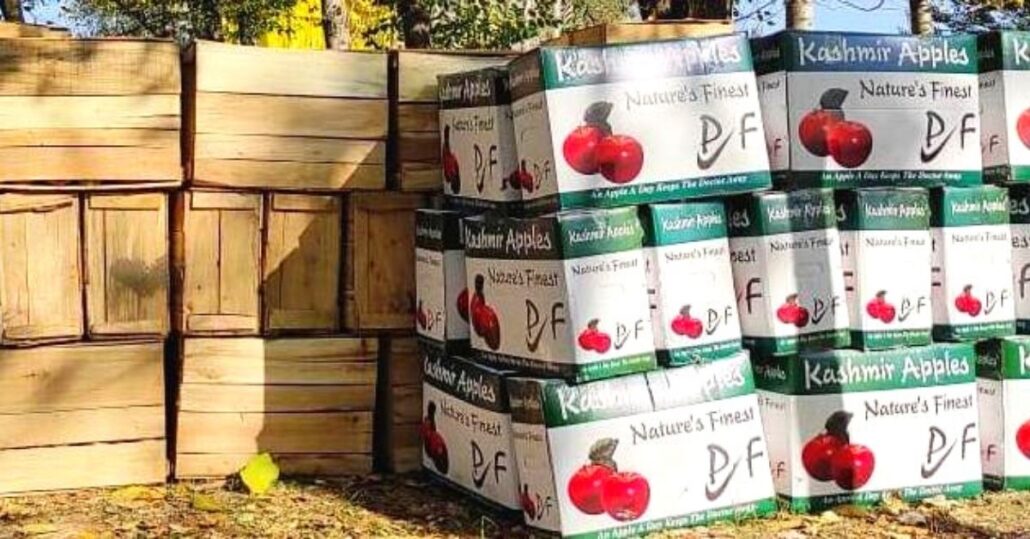
“We have 3 Lakh boxes packed in Kulgam, 80,000 boxes stacked in Shopian and nowhere to send them. Even if we manage to sell, the fruit will rot before reaching Delhi,” said Zahoor Ahmad of Kashmir Apple Farmers Federation He adde that from Sopore Mandi alone 200–300 trucks would leave with fruit daily. “Now many are stuck, others not even sent. The mandis are full of spoiled fruit.,” he told The Kashmiriyat.
Apple cultivation sustains 35 lakh people across Jammu and Kashmir, with an annual turnover of more than ₹17,000 crore. But growers say the ongoing disruption is pushing them to the edge. “The frequent highway closures have pushed us to the brink. What was supposed to cushion our incomes this harvest has become a burden we cannot bear,” said Altaf Ahmed, a Shopian grower.
At Delhi’s Azadpur mandi, buyers confirm irregular arrivals. “When Kashmir’s apples come late, quality drops and demand falls. Growers lose and so do we,” said Ramesh Gupta, a commission agent.
Shopian alone contributes nearly a third of Kashmir’s apples and is now described by locals as “buried under trucks,” with crates piled on roadsides and mandis choked. Pulwama, Kulgam, Anantnag, and Sopore are reporting similar gridlocks, with growers being asked to delay harvests, another potential loss. “This is not just about apples—it’s about survival,” said Farooq Ahmad, a farmer from Herman. “Our school fees, marriages, even hospital bills depend on this harvest. If the apples don’t move, our lives stop.”

- News Deskhttps://thekashmiriyat.co.uk/author/kashmiriyat/

- News Deskhttps://thekashmiriyat.co.uk/author/kashmiriyat/

- News Deskhttps://thekashmiriyat.co.uk/author/kashmiriyat/
- News Deskhttps://thekashmiriyat.co.uk/author/kashmiriyat/
