
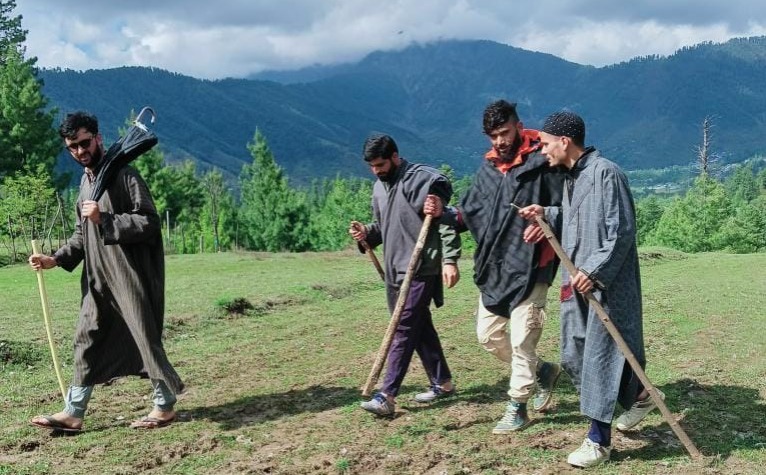
Farmers in Jammu Kashmir are increasingly burdened by mounting debt, underscoring the region’s agricultural struggles.
According to the National Statistical Office’s 77th round survey (2018-19), the average outstanding loan per agricultural household now stands at ₹30,435, up from ₹18,300 in the previous NABARD NAFIS 2016-17 survey.
While loans help finance agricultural activities, the rising debt levels reflect the growing financial strain on the region’s farmers, who face numerous obstacles that extend beyond just borrowing.
Despite Jammu Kashmir’s debt levels being lower than in more commercialized states, such as Punjab (₹2,03,249 per household), the increase in debt within the region is worrisome. While the state’s agricultural practices are less mechanized, the financial burden is nonetheless significant. Compared to states like Nagaland and Meghalaya, where the average debt is much lower, Jammu Kashmir’s rising debt signals a troubling trend—especially considering the region’s specific agricultural challenges.
The growing debt burden is not just a result of borrowing but reflects broader financial challenges, such as market fluctuations, climatic conditions, and limited access to formal credit. While loans provide short-term relief, many farmers find themselves caught in a vicious cycle of borrowing, making it harder to escape rising debt.
The increase in agricultural loans is a direct response to several pressing issues, most notably lower market rates for produce, frequent dry spells, untimely snowfalls, hailstorms, and unpredictable rainfall. Farmers are often left with reduced income due to these conditions, as their crops fail or underperform. For instance, a dry spell can deplete the water supply for irrigation, while hailstorms and untimely snowfalls can ruin crops that are already vulnerable due to changing climatic patterns.
In addition to climatic risks, farmers often receive delayed payments for their produce, which pushes them into debt just to manage basic expenses. Coupled with high transportation costs and limited access to markets, these factors intensify the financial distress in the region. Farmers, especially in remote areas, are often forced to seek loans from informal sources at high-interest rates, further exacerbating their financial burdens.
Moreover, the rise in input costs, including for seeds, fertilizers, and pesticides, adds to the challenge. With limited access to mechanized farming and advanced agricultural techniques, farmers face difficulties in achieving yields that can offset the rising cost of inputs.
While states like Andhra Pradesh, Kerala, and Haryana report higher levels of debt due to greater investments in mechanization and high-input farming, Jammu and Kashmir faces a different reality. The region’s farmers rely on traditional methods that are more vulnerable to climate-related uncertainties. The increase in borrowing, therefore, isn’t a result of commercialized, high-investment farming, but rather a response to increasingly unsustainable agricultural practices influenced by unpredictable weather patterns and limited infrastructure.
There is an urgent need for region-specific policies that address the challenges faced by Kashmiri farmers.

- News Deskhttps://thekashmiriyat.co.uk/author/kashmiriyat/

- News Deskhttps://thekashmiriyat.co.uk/author/kashmiriyat/

- News Deskhttps://thekashmiriyat.co.uk/author/kashmiriyat/
- News Deskhttps://thekashmiriyat.co.uk/author/kashmiriyat/
