

Sanjeev Sirohi
In a landmark judgment delivered, the Supreme Court upheld the use of Urdu on the signboards of the Municipal Council in Patur, Maharashtra, affirming that Urdu and Marathi hold equal status under the Indian Constitution.
The Court dismissed a petition challenging the inclusion of Urdu on the signboards, highlighting that language should not be tied to religion and reinforcing the idea that Urdu, like Marathi, is an integral part of India’s cultural and linguistic heritage. This ruling underscores the principle of unity in diversity and emphasizes the importance of linguistic inclusivity.
It is a matter of great significance with far-reaching implications that the Supreme Court, in a most learned, laudable, landmark, logical, and recent judgment titled Mrs. Varshatai W/o Sh. Sanjay Bagade vs. State of Maharashtra (Case Diary No. 24812 of 2024, cited in Neutral Citation No.: 2025 INSC 486), pronounced on April 15, 2025, has upheld the use of Urdu on the signboards of a Municipal Council in Maharashtra.
The Court explicitly stated that Urdu and Marathi have the same status under the Constitution. It must be noted that the Apex Court, while ruling in this case, dismissed the petition filed by Varshatai Sanjay Bagade, a former councillor of Patur town, who had challenged the use of Urdu on the signboards of the Municipal Council of Patur in Akola district, Maharashtra. The Court rightly pointed out that, due to a schism exploited by colonial powers to divide the two languages along religious lines, Hindi is now understood to be the language of Hindus and Urdu of Muslims—”a pitiable digression from reality; from unity in diversity; and the concept of universal brotherhood.” The Court further clarified that Urdu was born in India and cannot be tied to any particular religion.
At the very outset, this refreshing, remarkable, robust, rational, and recent judgment authored by Hon’ble Mr. Justice Sudhanshu Dhulia for a Bench of the Apex Court comprising of himself and Hon’ble Mr. Justice K. Vinod Chandran, sets the ball in motion by first quoting Mouloud Benzadi, who sagaciously said, “When you learn a language, you don’t just learn to speak and write a new language. You also learn to be open-minded, liberal, tolerant, kind, and considerate towards all mankind.”
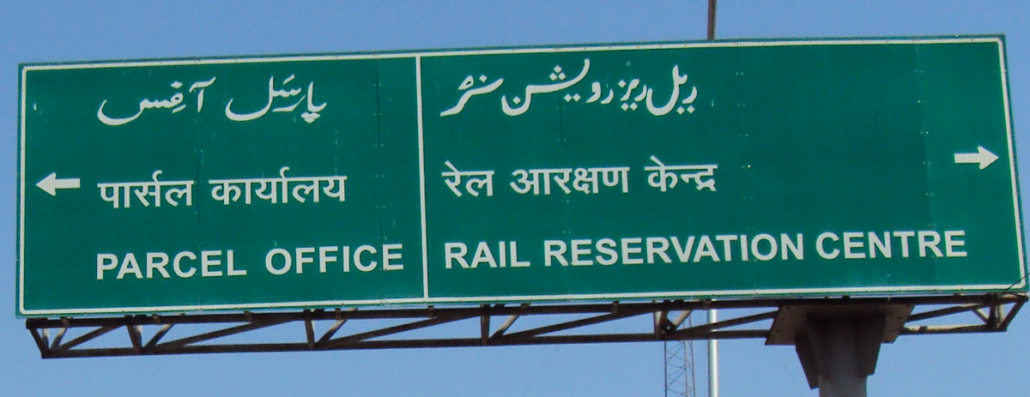
To put things in perspective, the Bench outlines in para 2 that, “The appellant before this Court is apparently not pleased with the use of Urdu on the signboard of the new building of the Municipal Council, Patur (hereinafter referred to as ‘Municipal Council’) in district Akola, Maharashtra. The board of the Council displays ‘Municipal Council, Patur’ in Marathi at the top, with its translation below in Urdu.”
As we see, the Bench points out in para 3 that, “According to the appellant, who is a former member of the Municipal Council, the work of the Municipal Council can only be conducted in Marathi, and the use of Urdu in any manner is impermissible, even though it may just be a writing on the signboard of the Municipal Council.”
In the fitness of things, the Bench very rightly points out in para 15 that, “The High Court, in our view, rightly concluded that the 2022 Act, on which the appellant placed significant reliance, does not prohibit the use of an additional language—Urdu in the present case—on the signboard of the Municipal Council building. The argument before the High Court in the second round of litigation by the present appellant was that Section 3(1) of the 2022 Act provides for Marathi to be the official language of all local authorities in the State, except for the purposes specified in sub-section (2), and the only exception provided was the use of English in specified communications under sub-section (2). All the same, this argument is incorrect. There is no prohibition on using any other language, especially one included in the VIIIth Schedule of the Constitution of India. Sub-section (2) of Section 3 is an enabling provision to use English in situations where the communication cannot be properly conveyed in Marathi or where the persons to whom such communications are addressed cannot understand Marathi. This makes it more than explicit that even the enactment recognizes that language is essentially a tool of communication, which, according to us, cannot be condemned when this language is being used by a community or group. We have to emphasize that Marathi and Urdu occupy the same position under Schedule VIII of the Constitution of India.”
Seen in this light, the Bench observes in para 16 that, “Before us is a fellow citizen who has taken great pains to take this matter twice to the High Court and then twice again before this Court. What the appellant thinks may also be the thinking of many of our fellow citizens. These need to be addressed.”
Do note, the Bench notes in para 17 that, “Let our concepts be clear. Language is not religion. Language does not even represent religion. Language belongs to a community, to a region, to people; and not to a religion.”
It would be instructive to note that the Bench notes in para 27 that, “The prejudice against Urdu stems from the misconception that Urdu is alien to India. This opinion, we are afraid, is incorrect as Urdu, like Marathi and Hindi, is an Indo-Aryan language. It is a language that was born in this land. Urdu developed and flourished in India due to the need for people belonging to different cultural milieus to exchange ideas and communicate amongst themselves. Over the centuries, it attained greater refinement and became the language of choice for many acclaimed poets.”
It is worth noting that the Bench observes in para 37 that, “Even today, the language used by the common people of the country is replete with words of the Urdu language, even if one is not aware of it. It would not be incorrect to say that one cannot have a day-to-day conversation in Hindi without using words of Urdu or words derived from Urdu. The word ‘Hindi’ itself comes from the Persian word ‘Hindavi’! This exchange of vocabulary flows both ways because Urdu also has many words borrowed from other Indian languages, including Sanskrit.”
Interestingly enough, the Bench points out in para 38 that, “Urdu words have a heavy influence on court parlance, both in criminal and civil law. From ‘Adalat’ (Adalat means ‘Court’) to ‘halafnama’ (Halafnama means ‘affidavit’) to ‘peshi’ (Peshi means ‘appearance’ or ‘presence’), the influence of Urdu is writ large in the language of the Indian Courts. For that matter, even though the official language of the Supreme Court and the High Courts as per Article 348 of the Constitution is English, many Urdu words continue to be used in this Court till date. These include ‘vakalatnama’, ‘dasti’, etc.”
Frankly speaking, the Bench very rightly concedes in para 39 that, “Viewed from another perspective, the Urdu language has come to be adopted by many States and Union Territories in India as the second official language in exercise of powers conferred by Article 345 of the Constitution (Please refer to the previous paragraphs of this judgment). The States which have Urdu as one of the official languages are Andhra Pradesh, Bihar, Jharkhand, Telangana, Uttar Pradesh, and West Bengal, while the Union Territories which follow this practice are Delhi and Jammu and Kashmir.”
Most remarkably, the Bench underscores in para 46, holding that, “Coming to the present case, it must be stated that a Municipal Council is there to provide services to the local community of the area and cater to their immediate day-to-day needs. If people or a group of people residing within the area covered by the Municipal Council are familiar with Urdu, then there should not be any objection if Urdu is used in addition to the official language, i.e., Marathi, at least on the signboard of the Municipal Council. Language is a medium for the exchange of ideas that brings people holding diverse views and beliefs closer, and it should not become a cause of their division.”
It would be worthwhile to note that the Bench lays bare in para 47, stating that, “These are the words of our former Chief Justice of India, M. N. Venkatachaliah, who makes a fervent plea for the preservation of Urdu while speaking in a seminar in Delhi, “The Urdu language has a special place in India. The Urdu language conjures up and inspires deeply emotive sentiments and thoughts, from the sublimity of the mystic to the romantic and the earthy, of perfumes of camaraderie, of music and life’s wistfulness, and a whole range of human relationships. Its rich literature and lore are a treasure house of the noblest thoughts on life’s mysteries. Urdu is not simply one of the languages of this country. It is a culture and civilisation in itself… But today this great culture needs urgent measures for its very survival… The richness of Urdu culture needs to be restored to its pristine glory.” (See Danial Latifi, Urdu in UP, Economic and Political Weekly, Vol. 36, No.7 (Feb 17-23, 2001), pp. 533-535 at p. 535).”
Most significantly and forthrightly, the Bench encapsulates in para 49 what constitutes the cornerstone of this notable judgment, postulating that, “The display of an additional language cannot, by itself, be said to be in violation of the provisions of the 2022 Act. The High Court, while reaching the above findings, had considered the relevant provisions of law. We completely agree with the reasoning given by the High Court that there is no prohibition on the use of Urdu under the 2022 Act or in any provision of law. The entire case of the appellant, to our mind, is based on a misconception of law. We see no reason therefore to interfere in the present case. These appeals are liable to be dismissed, and are hereby dismissed.”
Finally, the Bench then concludes by holding and directing in para 50 that, “Pending application(s), if any, stand(s) disposed of.”
In a nutshell, the Apex Court has made it indubitably clear that Urdu, which was born in India, cannot be tied to any religion. It also made it crystal clear that there is no legal bar on its use alongside Marathi. No denying it!

- News Deskhttps://thekashmiriyat.co.uk/author/kashmiriyat/

- News Deskhttps://thekashmiriyat.co.uk/author/kashmiriyat/

- News Deskhttps://thekashmiriyat.co.uk/author/kashmiriyat/
- News Deskhttps://thekashmiriyat.co.uk/author/kashmiriyat/

