


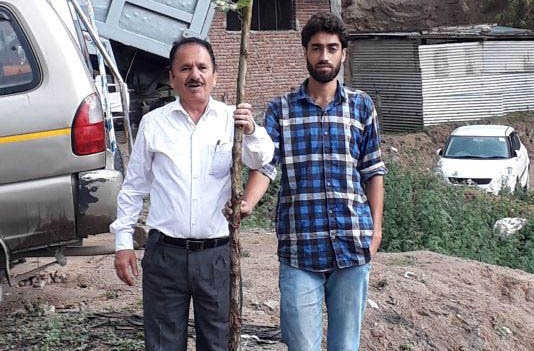
This World Environment Day, the Chenab Valley hills of Jammu echoed not with government slogans, but with the rustle of young Chinar leaves—planted by a retired professor determined to give the iconic Kashmiri tree a second life.
Prof. Syed Zaheer Abbas Hashmi, former principal of Government Degree College Doda and ex-Controller of Examinations at Cluster University Jammu, has spent the last 16 years planting thousands of trees across the region. His most remarkable effort: reintroducing the Chinar, once abundant in Kashmir but now in decline due to urbanisation, road projects, and ecological neglect.
While the Jammu Kashmir Forest Research Institute recently launched a ‘Digital Tree Aadhar’ initiative to geo-tag and monitor Chinars, Hashmi’s mission began long before. Since 2008, he has planted over 3,000 Chinar saplings in districts like Doda, Kishtwar, Bhaderwah, Bhalessa, and Thathri—often transporting the delicate plants himself from Kashmir. Despite a survival rate of just 20%, more than a thousand now stand tall, thanks to his personal care.
His green trail includes a 5-km stretch from Ghat to Doda and a 30-km patch from Pul Doda to Bhaderwah. Most saplings are planted on barren slopes, road embankments, and college campuses. Without institutional backing, Hashmi relies on his savings—buying, fencing, watering, and even carrying gallons of water during dry spells to keep the trees alive.
During his tenure at Bhaderwah College, he also led successful reforestation with native Deodar species. His early efforts as an NSS volunteer saw him bringing 20 kanals under fruit cultivation, and since then, he has built teams of student volunteers to take the mission forward.
While a state-sponsored effort under former Forest Minister Choudhary Lal Singh had also introduced Chinar saplings to Jammu, Hashmi’s work remains deeply personal. Just a day before Environment Day, one of his full-grown Chinars was burnt after a load carrier dumped garbage and set it alight. A complaint has been filed, but Hashmi remains undeterred.
“To me, a Chinar is not just a tree,” he says. “It’s culture, memory, shade—and resistance. It carries the soul of the Valley.” Thanks to his persistence, that soul is now quietly rooting itself in Chenab.


- News Deskhttps://thekashmiriyat.co.uk/author/kashmiriyat/

- News Deskhttps://thekashmiriyat.co.uk/author/kashmiriyat/

- News Deskhttps://thekashmiriyat.co.uk/author/kashmiriyat/
- News Deskhttps://thekashmiriyat.co.uk/author/kashmiriyat/

