

Sanjeev Sirohi
It is my strongest personal belief that the unwarranted, unexpected, and unjustified arrest of Shahi Jama Masjid Committee President and eminent, learned, and senior lawyer Mr. Zafar Ali—who commands a significant following not only among Muslims but also among many Hindus and members of other communities—could have been entirely avoided in connection with the November 24 violence in Sambhal.
Uttar Pradesh arrested Zafar Ali, also the head of the Shahi Mosque Committee, in connection with the November 24 violence in Sambhal that left four people dead. Sources claim he is being considered one of the “masterminds” behind the incident.
This violence erupted suddenly following a court order for the survey of a 500-year-old Mughal-era mosque, based on a petition claiming it was once the site of an ancient Hindu temple—a claim I believe is wholly unjustified.
It hardly bears repeating that the practice of searching for temples in every mosque is indefensible. I say without hesitation that courts must exercise the utmost restraint in ordering such surveys so freely, as doing so fosters discontentment, incites communal tension, and, tragically, causes loss of precious lives—as we witnessed in Sambhal. Such outcomes must be avoided at all costs.
Mr. Zafar Ali is a man of eminence and proven integrity, not a notorious criminal who poses a flight risk, that his arrest was so urgent that the police couldn’t even wait.
Naturally, his sudden and unjustified arrest sparked protests—not only in Sambhal but also in nearby districts—where lawyers staged a pen-down strike. One cannot ignore the significant fact that advocate groups across Sambhal district held large protests in various courts, alleging that his arrest was a deliberate attempt to prevent him from testifying before a judicial commission investigating the incident.
It is noteworthy that Mohammad Nazar Qureshi, President of the Chandousi Court Bar Association in Sambhal, stated:
“Various courts under the Sambhal district—Chandousi, Gunnaur, and Sambhal—remained closed today as part of the strike. There was no FIR against him, yet he was sent to jail under unspecified charges. This is a wrongful act by the police.”
Even the Hapur Bar Association commendably expressed its support and abstained from work in solidarity on March 26, 2025.
Surely, we must ask: How can such a despicable act be justified under any pretext? How can an eminent senior lawyer like Mr. Zafar Ali be sent to jail without due process? This not only severely tarnishes our international image but also constitutes a blatant violation of the legal rights of a practicing advocate—an officer of the court—something the police must always remember.
On a personal note, I strongly believe that all lawyers, regardless of religion, caste, community, creed, or gender, must unite—not only in Sambhal, not just in western UP, or across Uttar Pradesh—but across all of India, in firm and unflinching solidarity with Mr. Zafar Ali, one of the most senior and respected lawyers from Chandausi, Sambhal. This crisis clearly underscores the urgent need to implement the long-pending Advocate Protection Act without further delay.
Let us not ignore the crucial provision in Section 11 of the proposed Advocate Protection Act, which authorizes courts to compensate advocates for wrongs committed against them. It clearly states:
“No police officer shall arrest an advocate or investigate a case against an advocate without the explicit direction of the Chief Judicial Magistrate.”
Had this law been in force—as lawyers across India have long demanded—Mr. Zafar Ali would not have been unfairly incarcerated without even an FIR.
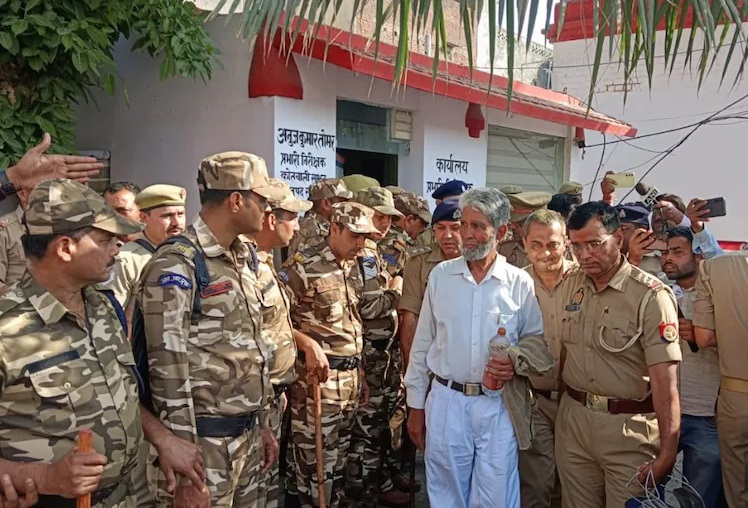
With decades of distinguished service in the district courts, it is deeply shocking that Mr. Zafar Ali was made to languish in jail without an FIR. I am left shaking my head in disbelief: how can such a senior lawyer be imprisoned and treated so poorly? As he was being escorted to jail, Mr. Zafar Ali firmly told reporters:
“I did not incite any violence.”
His unwarranted arrest must be condemned in the strongest parliamentary terms.
What is even more astonishing is that his advocates and family members were denied access to meet him—an action that cannot be justified under any circumstances. His family alleges that he was transferred to Moradabad Jail and that his life is in danger—an allegation that cannot be taken lightly. They further claim he has been denied his essential medication, which is utterly deplorable and must be condemned in the harshest terms, as it threatens his very survival.
Speaking to reporters, his elder brother, Mr. Mohammad Tahir Ali—also a lawyer—stated: “He is being treated as if he is a hardened criminal.
He further alleged that Mr. Zafar Ali’s life is at risk inside the prison.
In anguish, Mr. Tahir Ali added:
“He is 70 years old, and even his medicines are being withheld. The police are misbehaving, and the administration has crossed all limits.”
He claimed the arrest was a deliberate move to prevent Mr. Ali from testifying before a judicial commission scheduled for March 24.
“Zafar was supposed to testify before the commission tomorrow, and that is why they are deliberately sending him to jail,” he told reporters.
He also accused the administration of escalating tensions, citing Mr. Zafar Ali’s final words before being taken into custody:
“No problem, I am ready to go to jail. I will not back down from the truth.”
This speaks volumes about his strength of character and moral courage.
It is equally important to note that Mohammad Islam, President of the District Bar Association of Sambhal, reaffirmed unwavering support for Mr. Zafar Ali. I am confident that lawyers across all specializations will stand by him during this ordeal. The Bar Council of India must urgently intervene and press the police to stop harassing him and his family. The Uttar Pradesh Bar Council must also act in full solidarity with him during this hour of need—I hope they will not disappoint.
In conclusion, the Supreme Court must take suo motu cognizance of the increasing violations of lawyers’ rights and urgently mandate the implementation of the Advocate Protection Act, which enjoys broad support from the Supreme Court Bar Association and other legal bodies across India. Police officers who unlawfully arrest lawyers must be punished and penalized, so they are deterred from acting arbitrarily or under political pressure. This is not a matter that can be delayed any longer.
The pressing question is: How much longer will it take to implement the long-awaited Advocate Protection Act? I sincerely hope it doesn’t take so long that we never get to see its strict implementation in our lifetime. The time for action is now.
Let us also consider how other countries protect their legal professionals. Article 296 of Russia’s Criminal Code, Section 1503 of Title 18 of the United States Code, Article 54 of Egypt’s Advocacy Law No. 17 of 1983, and Article 15 of Indonesia’s Law No. 18 of 2003—all provide commendable protections to the legal profession. The Charter of Core Principles of the European Legal Profession (2006) underscores the lawyer’s independence—political, economic, and intellectual—in advising and representing clients.
This means that lawyers must be entirely independent of state control and other vested interests. Even Pakistan’s National Assembly has enacted The Lawyers Welfare and Protection Act, 2023, to ensure that advocates can carry out their professional duties without fear or interference. This clearly shows that the global trend is toward stronger legal protections for advocates—essential actors in the administration of justice. India must not lag behind.
Ultimately, the unwarranted arrest of Mr. Zafar Ali, without even an FIR, is deeply troubling. Such actions will have a chilling effect on the independence of the legal profession, which cannot be allowed to continue unchecked. It is simply incomprehensible why the Advocate Protection Act has remained in legislative limbo for so long. But no more. Enough is enough. It now brooks no further delay.
Sanjeev Sirohi is a legal expert based in Uttar Pradesh. He writes legal articles for The Kashmiriyat.


- News Deskhttps://thekashmiriyat.co.uk/author/kashmiriyat/

- News Deskhttps://thekashmiriyat.co.uk/author/kashmiriyat/

- News Deskhttps://thekashmiriyat.co.uk/author/kashmiriyat/
- News Deskhttps://thekashmiriyat.co.uk/author/kashmiriyat/

