Syed Zeeshan Ali
In the winter of 1978, as revolutionary fervor gripped Iran and Ayatollah Ruhollah Khomeini faced expulsion from Iraq, an unusual letter reached him in Najaf—from the Himalayan valley of Kashmir. It was sent by Aga Syed Yusuf, one of Kashmir’s most influential Shia clerics, offering Khomeini refuge and spiritual kinship in what he described as the “ancestral land” of the exiled leader. Khomeini, then on the brink of returning to Iran to lead the final stage of the revolution, declined the invitation. Yet in his response, he acknowledged something remarkable: his connection to Kashmir.
This exchange was more than a personal footnote—it reflected the survival of a shared memory, a deep-rooted cultural and spiritual kinship that had endured across centuries and mountain ranges. Long before modern political borders carved up the Islamic world, Kashmir had been an integral part of an interconnected Persianate civilization—a transregional cosmopolis shaped by a common language, aesthetic sensibility, theological outlook, and bureaucratic tradition. From the 14th to the 19th century, Kashmir was often known as Iran-e-Sagheer, or Little Iran—not as a metaphor, but as a civilizational fact.
According to tradition, Khomeini’s grandfather, Syed Ahmad, migrated from Kashmir to Najaf in the mid-19th century and eventually settled in the Iranian town of Khomeyn. There, Khomeini’s father, Syed Moustafa, was born. Moustafa later studied in Najaf and Samarra before returning to Iran. Though definitive genealogical proof remains elusive, Aga Syed Yusuf pursued the matter through archival research and correspondence, uncovering partial affirmation. Years later, Aga Syed Baqir wrote that regional records do indeed mention a Syed Ahmad who departed Kashmir under mysterious circumstances—adding weight to the belief that Khomeini’s ancestral roots may trace back to the Valley.
But this story is not merely a genealogical curiosity. It points to a far deeper historical reality: a centuries-old Indo-Persian cultural continuum that once bound Kashmir and Iran together through a shared language, religion, philosophy, and mysticism.
This essay reclaims that forgotten world. Drawing on historical sources and cultural memory, it explores how Persian language, mysticism, aesthetics, and political thought shaped the soul of Kashmir. It weaves together two strands: the theological and philosophical currents brought by Iranian Sufi scholars, and the literary and bureaucratic authority of Persian that made Kashmir a key node in the larger Indo-Iranian world. What emerges is not simply a tale of influence, but a portrait of Kashmir as a cultural and spiritual twin of Iran—rooted, radiant, and nearly forgotten.
Persianate Spiritual Foundations: Mysticism, Migration, and Sacred Ties
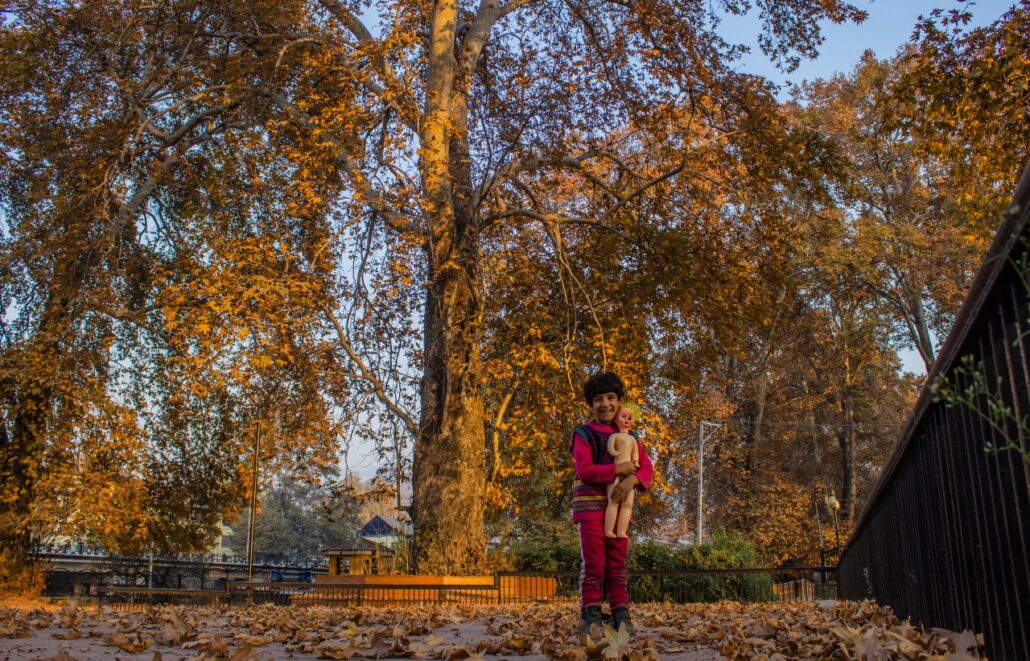
The story of Kashmir’s Persian turn begins with the arrival of Sufi polymaths from Iran, most notably Mir Syed Ali Hamdani—revered locally as Shah-e-Hamdan. Arriving in Kashmir in 1372 for his second visit, Hamdani brought with him 700 followers, many of whom were master artisans: calligraphers, woodcarvers, metalworkers, and weavers. They introduced carpet weaving, papier-mâché, tilework, khatamband ceilings, and wood carving, laying the aesthetic foundations of Kashmiri architecture and crafts that endure to this day. Even the ubiquitous Chinar trees of the Valley are believed to have been brought by his entourage.
Hamdani’s contribution was not merely aesthetic. He institutionalized the Waqf system, established khanqahs, and penned Zakhirat-ul-Muluk, a Persian manual on governance. His impact transformed the Valley’s spiritual and economic order, anchoring it to the broader Iranian cultural sphere.
While Shah-e-Hamdan is the most frequently mentioned link between Iran and Kashmir, there were other important, though lesser-known, figures from the Safavid era who maintained strong ties with Kashmiri Sufi orders. One such figure is Mir Shams-ud-Din Iraqi, a 15th-century saint of the Nurbakhshi order, which had deep roots in Iran. His tomb in Zadibal remains a significant pilgrimage site for devotees. What’s particularly interesting is that Iraqi’s arrival in Kashmir predates the Safavid Empire’s official adoption of Shi’ism in 1501. This fact reveals how receptive Kashmir was to Iranian sectarian theology even before Iran itself had fully embraced Islam as the state religion.
Moving beyond theology, Iranian influence is clearly visible in Kashmiri religious architecture. The wooden latticework, muqarnas-style cornices, and the distinctive conical domes of shrines such as Khanqah-e-Moula, Zadibal, and Chrar-e-Sharif showcase strong Timurid-Isfahani design influences. Even the floral motifs found in Kashmiri tilework and paper mâché art (naqashi) are directly inspired by Safavid aesthetics from Isfahan. This rich artistic lineage remains underappreciated but highlights the deep cultural ties between Kashmir and Iran.
Between the 18th and 20th centuries, many Kashmiri clerics traveled to or taught in Iraqi and Iranian seminaries. For instance, Mulla Abdul Nabi Kashmiri, a prominent 19th-century jurist, taught in Karbala and Najaf and corresponded with scholars in Mashhad. Another example is Aga Syed Yusuf Al-Moosavi, mentioned earlier, who received his religious education in Iran before returning to lead the Shia community in Budgam. Many of these Kashmiri ulama took part in translating Iranian religious texts into a more vernacularized form of Persian, making the jurisprudence and teachings of Qom-style more accessible to readers in Kashmir.
Iranian influence extended into governance and administration as well, especially during the Mughal and Afghan periods. Kashmiris trained in Iran were often appointed to important roles such as tax assessors, translators, and qadis—not just within Kashmir but also as emissaries to other Indian courts, including those in Awadh, Bengal, and the Deccan. Archival documents from Kabul to Kashmir bear similar seals and scribal styles, often penned by Kashmiri scribes highly fluent in Iranian idioms. The term “Kashmiri Munshi” became synonymous across northern India—from Lucknow to Lahore—with Persian literary and bureaucratic excellence.
The epithet Iran-e-Sagheer—or “Little Iran”—was not merely a poetic nickname. It was an aspirational identity. It reflected how Kashmiri rulers, Sufi saints, and scholars envisioned their polity as part of a wider transregional Persianate republic of letters and culture. Unlike the British-imposed term “Princely State,” Iran-e-Sagheer implied that Kashmir was an autonomous, cosmopolitan region standing shoulder to shoulder with great Persianate centers like Isfahan, Herat, and Shiraz—not as a subordinate colony but as a co-equal partner within the Islamic world.
This deep connection with Iran also remained alive in the Kashmiri imagination well into the 20th century. During Iran’s Constitutional Revolution from 1905 to 1911, Kashmiri newspapers such as Roshni and Vakil Srinagar published editorials supporting the Iranian modernist movement. Later, after the 1979 Islamic Revolution resonated strongly in parts of Kashmir like Budgam and Kargil, where Iran-e-Sagheer reemerged in religious pamphlets and sermons. The name Iran-e-Sagheer was even used in Kashmiri textbooks as late as the 1980s to emphasize Kashmir’s unique place within the world.
Literary Sovereignty and the Rise of Persian in Kashmir
Before the arrival of Islam, Kashmir stood as a bastion of Sanskritic culture. Thinkers like Kalidasa, Bilhana, and Kshemendra shaped the Valley’s literary and philosophical life, while Kalhana, author of the Rajatarangini in the 12th century, famously claimed he was a poet first and a historian later. Yet, with the advent of Islam—carried largely by Iranian scholars, Sufi mystics, and traders—Persian gradually replaced Sanskrit as the dominant language of court, culture, and spirituality.
This civilizational transition matured under enlightened monarchs like Sultan Zain-ul-Abidin (Budshah), who reigned in the 15th century. Himself a poet who wrote under the pen name “Qutb,” Zain-ul-Abidin founded a Dar-ul-Tarjuma (Translation Bureau) and a university in his capital. He actively supported the translation of Sanskrit texts, including Kalhana’s Rajatarangini, into Persian—setting the stage for a unique fusion of Indo-Iranian sensibilities. Under his patronage, the cross-pollination of Kashmiri and Persian cultures reached its apex.
From this fertile soil emerged a dazzling constellation of Persian scholars and poets. Ghulam Muhyiuddin Sufi, in his magisterial Kashmir: Being a History of the Valley, categorized Kashmir’s Persian literary tradition into three distinct periods—Pre-Mughal, Mughal, and Post-Mughal/Afghan—and documented more than 200 significant poets. Among them, Mohammad Tahir Ghani Kashmiri, Sarfi, Mohsin Fani, and Mohammad Aslam Salim stand out. Ghani Kashmiri’s metaphysical depth and linguistic innovation were so renowned that the celebrated Iranian poet Saaib Tabrizi traveled all the way from Isfahan to Srinagar to meet him. As legend goes, Saaib even offered his entire diwan in exchange for a single couplet by Ghani—a testament to the Kashmiri’s extraordinary stature in the Persianate world.
Kashmir was not only producing poets—it was inspiring them. Mughal courtiers and emperors held the Valley in awe. Poets like Talib Amuli, Kalim, and even the prince Dara Shikoh composed Persian ghazals infused with the mystique of Kashmir’s landscapes and Sufi spirit. Talib Amuli, court poet to Jehangir, wrote prolifically on the beauty and political complexity of Kashmir. Jehangir and Shah Jahan visited frequently, not merely for respite but to partake in its literary and spiritual offerings.
The Valley’s Persianate heritage wasn’t confined to Muslims alone. Kashmiri Pandits—Dhars, Kouls, Tickoos—became masters of Persian to ascend the ranks of Mughal and Afghan administration. According to one claim, Jawaharlal Nehru’s ancestor, Raj Koul, was a Persian scholar invited to Delhi by Emperor Farrukhsiyar, though historian Muhammad Yousuf Teng disputes this. Regardless, the assertion itself reflects the prestige Persian once commanded in Kashmiri society.
Beyond courtly and poetic circles, Persian was the language of religious devotion and metaphysical inquiry. Sufi literature and mysticism entered Kashmiri life through Persian, deeply influencing spiritual expression. The Rishi order, which came to define indigenous Kashmiri Islam, was shaped by Persian Sufi texts. Baba Dawood Khaki’s Asrar-ul-Abrar (Secrets of the Pious) documented the life and teachings of Sheikh Nooruddin Noorani, integrating Persianate metaphysics with local traditions. Works like Waqat-e-Kashmir by Mohammad Azam Dedmari, Gulistan-e-Akhlaq and Kharat-e-Asrar by Pir Hassan Shah, and Tarikh-e-Kashmir by Syed Ali continue to serve as key archival reservoirs of Persian scholarship in Kashmir.
The intellectual and spiritual atmosphere of Kashmir remained deeply suffused with the works of Persian giants like Jalaluddin Rumi, Hafiz of Shiraz, Saadi, and Attar. Their verses, often memorized and recited in Khanqahs, classrooms, and homes, shaped Kashmir’s collective moral and emotional grammar. Rumi’s Masnavi was studied not just as poetry, but as divine philosophy. Hafiz’s lyrical mysticism resonated across sectarian and social divides—his Divan was consulted in moments of personal and political uncertainty, often used for fal (divination) well into the 20th century.
Shiraz itself held mythic stature in Kashmiri imagination. Kashmiri poets invoked it as both a literal and symbolic homeland—representing refinement, love, and divine longing. Even in the 19th and early 20th centuries, Kashmiri scholars such as Haji Mukhdoom and Muhammad Amin Pandit translated or imitated Persian classics, keeping the flame alive as colonial rule began to reorient Kashmir’s cultural compass toward Urdu and English.
To this day, remnants of this Persianate heritage linger in Kashmir’s speech, aesthetics, and religious life. The titles of books, phrases in everyday language, gravestone inscriptions, and even wedding songs echo the rhythms of a world once bound to Isfahan, Shiraz, and Mashhad.
Ritual Continuities and the Afterlife of Iran-e-Sagheer
Persian’s role in Kashmir extended far beyond the page. It shaped ritual life, architecture, and seasonal practices. Shrines like Khanqah-e-Moula, Chrar-e-Sharif, and Zadibal Imambara continue to reflect Iranian architectural motifs: muqarnas, floral tilework, conical domes, and intricately carved woodwork. Within these spaces, spiritual and cultural rituals carried Iranian echoes.
One of the most enduring Persian traditions in Kashmir is Nauroz—the Iranian New Year. Celebrated on the spring equinox, Nauroz symbolizes cosmic balance, renewal, and spiritual prosperity. Even today, pockets of rural Kashmir mark the day with sufra-e-shah feasts (dedicated to Imam Ali), lotus stem delicacies, and the singing of traditional Roff songs by women. The practice of observing tehvil—the exact moment of solar transition—is a living testimony to Persian cosmology.
Ghulam Mohuddin Sufi, in the second volume of Kashmir: Being a History…, noted how Persian influence predated even the Islamic period. After the Arab conquest of Iran in the 7th century, many Zoroastrians fled to India—some making their way to Kashmir. These early migrants brought with them trade skills, literature, and language that laid the groundwork for later Persian integration.
Yet, the decline came swiftly. With the fall of the Mughals and the rise of the Dogras and British, Persian lost its official status. In 1889, Maharaja Pratap Singh replaced Persian with Urdu, severing a centuries-old linguistic umbilical cord. British educational policy further pushed English as the language of opportunity, leaving Persian to linger only in religious seminaries and private homes.
Still, the echo remains. Clerics from Budgam study in Qom and Mashhad. Local seminaries continue to teach Kashmiri children about Iran-e-Sagheer. Oral histories of the Khomeini lineage, Nauroz celebrations, and manuscripts in private collections ensure that Persian’s afterlife is not over.
In remembering Kashmir as Iran-e-Sagheer, we do not indulge in nostalgia. We recover a worldview in which Kashmir stood not on the margins but at the center of an Islamic cosmopolis. We rediscover a Valley where the calligraphy of Ghani Kashmiri rivaled that of Shiraz, and where the mysticism of Hamdani resonated with the spirituality of Hafez. To reclaim this heritage is not only a matter of cultural pride—it is an act of intellectual sovereignty.
This memory must now be rescued. Libraries must be digitized, Persian manuscripts translated, and educational reforms initiated to reconnect Kashmiri youth with their Persianate roots. The mountains that once carried poetry and mysticism between Hamadan and Srinagar are still there. It is now up to us to rewalk those paths—and let Iran-e-Sagheer rise once more.

- News Deskhttps://thekashmiriyat.co.uk/author/kashmiriyat/

- News Deskhttps://thekashmiriyat.co.uk/author/kashmiriyat/

- News Deskhttps://thekashmiriyat.co.uk/author/kashmiriyat/
- News Deskhttps://thekashmiriyat.co.uk/author/kashmiriyat/
