

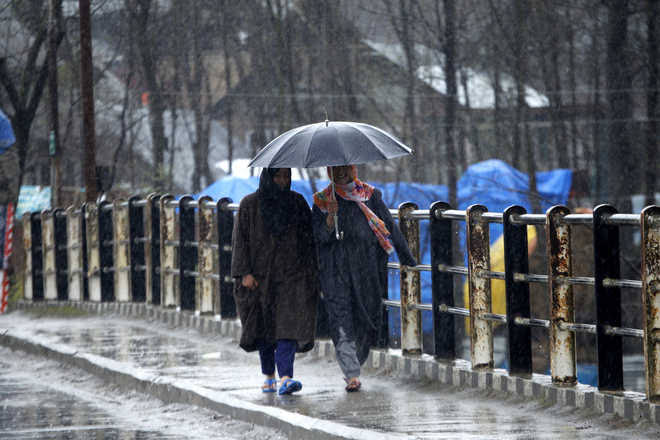
The much-awaited rainfall, since Tuesday afternoon, has brought relief and joy to Kashmiris across sections.
With the winter months recording an alarming 87% rainfall deficit, this spell of precipitation comes as a blessing, replenishing water sources and easing concerns over a looming drought.
Srinagar received 7.8 mm of rain, while Qazigund recorded 12.2 mm. Pahalgam saw 20.8 mm, and Gulmarg, blanketed in fresh snow, recorded 33.0 mm of precipitation, translating into 33.0 cm of snowfall.
Kupwara received 20.3 mm of rain with 1.5 cm of snow, while Sopore and Bandipora witnessed 32.0 mm and 26.5 mm of rain, respectively. Nowgam Handwara recorded the highest rainfall in the valley at 36.4 mm.
The rains extended across south Kashmir, where Anantnag received 3.0 mm, Kokernag 6.4 mm, and Verinag 8.2 mm. Shopian saw 12.0 mm, Kulgam 9.5 mm, and Pulwama and Tral recorded 1.0 mm each. In central Kashmir, Budgam received 9.0 mm, Ganderbal 13.5 mm, and Charar-i-Sharief 5.4 mm. Baramulla saw 19.5 mm, Asham 21.0 mm, and Wular 27.0 mm, further replenishing the water bodies.
The rainfall was widespread in the Jammu region as well, with Banihal receiving the highest at 38.8 mm, followed by Batote at 30.1 mm and Poonch at 30.0 mm.
Kishtwar recorded 19.0 mm, Ramban 14.5 mm, and Bhaderwah 16.0 mm. Jammu itself saw 1.4 mm of rain, while Katra recorded 3.2 mm. Reasi and Bakore received the lowest, at 0.5 mm each.
Ladakh remained largely dry, with no precipitation reported from Leh, while data from Kargil and Drass remains unavailable.
The latest weather system, a moderate-intensity Western Disturbance, has set the stage for more precipitation over the next two days.
While higher reaches will continue to receive snowfall, rain will dominate the plains.
Weather officials predict intermittent showers until February 27, with a stronger spell expected between the night of February 27 and February 28.
Some plains may even witness snow if temperatures drop further. The weather is expected to improve by the afternoon of February 28.


- News Deskhttps://thekashmiriyat.co.uk/author/kashmiriyat/

- News Deskhttps://thekashmiriyat.co.uk/author/kashmiriyat/

- News Deskhttps://thekashmiriyat.co.uk/author/kashmiriyat/
- News Deskhttps://thekashmiriyat.co.uk/author/kashmiriyat/

