

Syed Murtaza
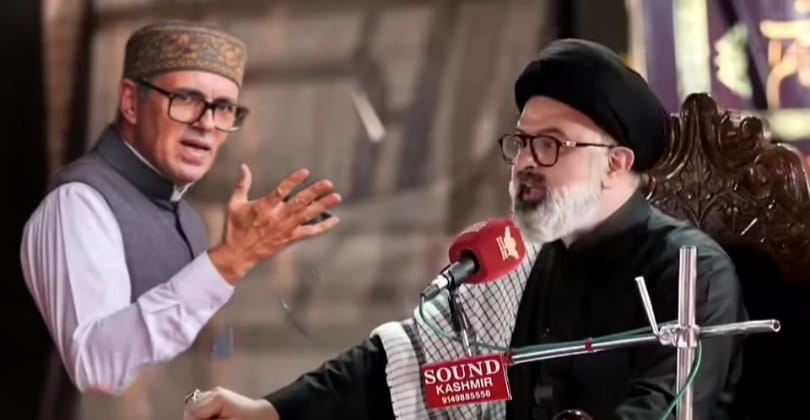
In Kashmir, contradictions often emerge in the most unexpected ways. A Srinagar-based news agency recently made a startling misstep: in commenting on a video of senior Shia cleric Aga Syed Mohammad Hadi criticizing Chief Minister Omar Abdullah, the channel labeled the prominent religious leader an “RSS Molvi,” implicitly siding with the CM. The irony is sharper because this same channel has long been a key player in censorship, a practice Omar himself frequently critiques. If any new media outlet were openly aligning with the right wing, it was this one. This is Kashmir for you.
The twists do not end there. On social media, former critics of Aga Hadi; Kashmiris who previously opposed him for his Shia identity even when he was speaking on Muslim unity, Gaza, and the dignity of Kashmiris, are now showering him with praise. Many who once dismissed or “canceled” him are now embracing him as a moral voice.
As one political commentator observes, a party has effectively hijacked the Kashmir narrative for several decades, shaping perceptions so that “resistance” is equated with speaking against mainstream parties like the NC, PDP, and others. In political sociology, this is often linked to Gramsci’s concept of hegemony, where a group of people controls the cultural, political, and social narratives to maintain power, effectively using the masses as a tool for their own agenda.
This latest controversy has unfolded in the context of Omar Abdullah’s statement on August 15, when he claimed that Kashmiris were unhappy and announced an eight-week statewide campaign to demonstrate popular support for the restoration of statehood to the Supreme Court. On August 14, 2025, the Supreme Court had granted the central government eight weeks to respond to a petition on statehood restoration, stressing that ground realities, including the Pahalgam massacre, must be considered.
CM Omar Abdullah, seizing this window, launched a door-to-door signature campaign across all 90 assembly constituencies, pledging to submit signatures, backed by thumb impressions where necessary, to both the Supreme Court and the Centre. He rejected any linkage between statehood restoration and terrorism: “Will the killers of Pahalgam … decide whether we will be a state? … Why are we being punished for a crime in which we had no role?”
In referencing Pahalgam, the Chief Minister misinterpreted CJI Gavai’s remarks as a critique of the statehood demand itself. In reality, the CJI was responding to arguments presented by the Solicitor General. Media outlets favorable to the CM reported it differently, shaping public perception to fit a narrative, a classic case of agenda-setting, where the media determines which issues the public perceives as important and how.
The opposition has been unrelenting. Aga Syed Mohammad Hadi, long marginalized for his Shia identity, is emerging as a unifying voice. In his Arbaeen gathering speech, he sharply criticized Chief Minister Omar Abdullah, calling his door-to-door signature campaign “superficial” and accusing him of exploiting people’s sentiments rather than addressing genuine concerns. Hadi questioned Omar’s moral right to remain in the ministry if he could not deliver on promises, condemned compromises on people’s rights for personal gains like “salary and luxury cars,” and urged him to step away from “incompetent politics” and a party that has repeatedly betrayed the people of Kashmir.
Interestingly, the support Aga Hadi received was immense, and the very Srinagar-based news agency that had criticized him in a Facebook comment calling him an “RSS Molvi” , has in the past, published his press releases more than any other outlet. This mirrors the concept of the “performative media cycle,” where media entities oscillate between criticism and amplification depending on political expediency.
The irony does not end here. A spokesperson for the ruling party has labeled critics of the signature campaign as BJP agents, the claim may hold truth, in a place of such paradoxes. The party claims it does not care about social media, yet it clearly does, facing a unipolar and relentless campaign against it. While it is attentive, the party shows little willingness to actively challenge misinformation. In the process, it allows historical amnesia and selective framing to shape public discourse or perhaps they do not engage with history, even that of their party.
Omar Abdullah’s campaign raises a key question: is it undermining the electoral process he already commands a mandate for? By bypassing legislative procedures and appealing directly to citizens, the CM risks converting genuine democratic sentiment into symbolic theatre. Yet, in a valley where principled and genuine voices like Aga Hadi’s are rare, authenticity often outweighs partisanship.
Kashmir today is a hall of mirrors: politics, media, religion, and social sentiment reflect and refract each other endlessly. Omar Abdullah’s campaign teeters between genuine grassroots mobilization and theatrical spectacle, while Aga Hadi’s rising public stature illustrates how integrity and moral authority can be co-opted by opportunists to serve their own political agendas.
Amid all this, the Supreme Court’s eight-week directive provides both a legal framework and a symbolic deadline, forcing actors to consider whether their gestures truly advance justice, or simply reverberate in the chamber of optics.
In Kashmir, nothing is static. Every political move, media report, and religious statement is subject to reframing. The challenge remains: to discern substance from spectacle and authenticity from artifice in a place where the two are often indistinguishably intertwined.

- News Deskhttps://thekashmiriyat.co.uk/author/kashmiriyat/

- News Deskhttps://thekashmiriyat.co.uk/author/kashmiriyat/

- News Deskhttps://thekashmiriyat.co.uk/author/kashmiriyat/
- News Deskhttps://thekashmiriyat.co.uk/author/kashmiriyat/

