
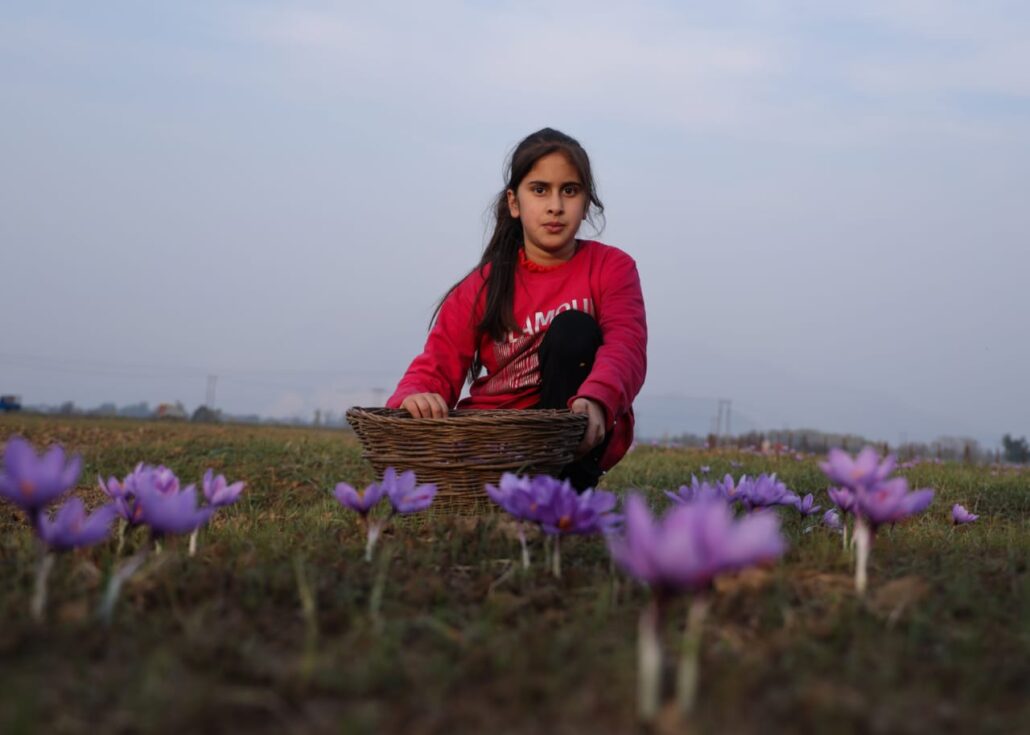
Once known for producing the world’s finest saffron, Pampore, the saffron town of south Kashmir’s Pulwama district, has been continuously witnessing a sharp decline in saffron cultivation and yield, with growers raising alarm over the complete failure of the National Saffron Mission (NSM) on the ground.
Farmers and stakeholders alleged that despite a Rs 400 crore investment under the National Saffron Mission, the project has failed to rejuvenate saffron cultivation or provide the much-needed sprinkler irrigation facilities.
Ashiq Hussain, a saffron grower from Pampore, said the entire project has remained confined to paperwork. “We’ve been hearing about the mission for over 15 years now, but nothing has changed on the ground. There’s a Spice Park in Dusoo and we have GI tagging, but what use is it when reproduction is in decline?” he asked.
He said that despite assurances, no functional irrigation system has been implemented, leaving fields dry and productivity stunted. “Currently, it is time for the irrigation process of our saffron fields, but despite spending crores, farmers still rely on rains,” he said.
Growers said the production in 2024 was only 30–40 per cent of the expected output, continuing a decade-long downward trend, and it is going to decline further if positive steps are not taken.
According to official data, the area under saffron cultivation has dropped from 5,707 hectares in 1996–97 to just 2,387 hectares by 2019–20—a staggering 65 per cent decline.
Ghulam Rasool, another distressed grower, warned of dire consequences if immediate measures are not taken. “Every year the yield is falling. If this continues, there will be no saffron left in Pampore by 2030,” he said. “The government must act now—stop the blame game and focus on reviving this heritage crop.”
Growers said that three main challenges plaguing the saffron industry include lack of irrigation infrastructure, especially sprinkler systems, the unavailability of quality saffron corms, and rapid conversion of saffron land for other agricultural or commercial uses.
Some farmers have already shifted to other crops like mustard, while others are moving towards horticulture due to low returns from saffron.
The growers are now demanding an in-depth probe into the National Saffron Mission, alleging large-scale failure and possible mismanagement of funds.
“This was a Rs 400 crore project. Where has the money gone? Why are there no irrigation systems in place?” questioned one of the farmers. “Those responsible must be held accountable so that the people get the promised facilities and this dying crop gets a chance at revival.”
They appealed to Chief Minister Omar Abdullah and the Agriculture Minister to personally intervene in the matter and ensure revival efforts are seriously pursued. They said that if immediate and serious steps are not taken—especially regarding irrigation, seed availability, and land protection—the future of Pampore’s saffron industry looks bleak. (KNO)

- News Deskhttps://thekashmiriyat.co.uk/author/kashmiriyat/

- News Deskhttps://thekashmiriyat.co.uk/author/kashmiriyat/

- News Deskhttps://thekashmiriyat.co.uk/author/kashmiriyat/
- News Deskhttps://thekashmiriyat.co.uk/author/kashmiriyat/
