

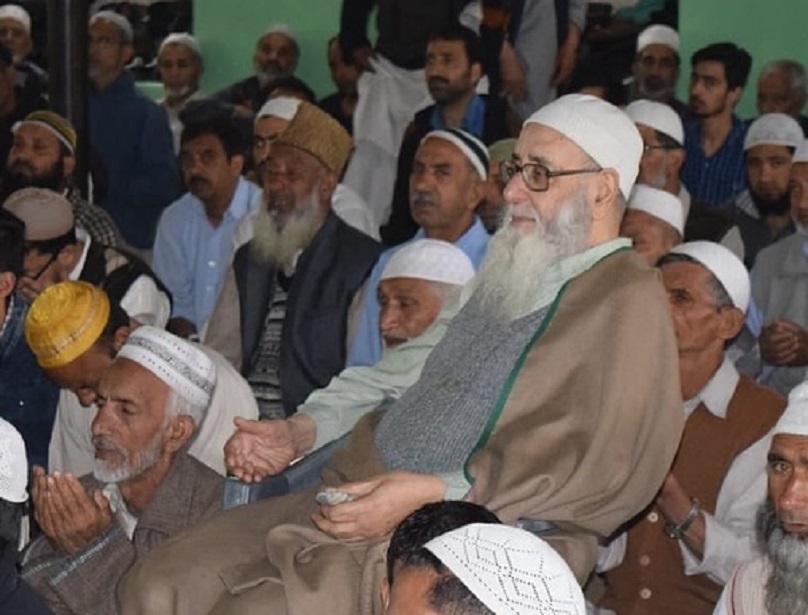
On May 2, 2025, Srinagar witnessed the passing of Mubarak Mubarki, a leading voice associated with the Salafi (Ahli Hadees movement) tradition, whose work left an indelible mark on the intellectual life of Kashmir. His influence spanned generations, yet he carried his role with quiet seriousness rather than spectacle.
Mubarki was born into a family deeply rooted in intellectual and ethical traditions, particularly shaped by his father, Ghulam Nabi Mubarki, a revered figure in Kashmir’s religious and intellectual community. Ghulam Nabi Mubarki, known for his own contributions to religious scholarship, played a pivotal role in shaping his son’s worldview. His father’s unwavering commitment to knowledge, moral integrity, and community service became the foundation on which Mubarki built his own life’s work.
The values of honesty, restraint, and an unyielding pursuit of learning that he inherited from his father would go on to define Mubarki’s academic and spiritual journey.
Raised in an atmosphere where learning and ethical conduct were inseparable, Mubarki’s early years were shaped by these values. His academic journey took him beyond Kashmir, to seminaries across the subcontinent, where he studied the Qur’an, Hadith, and other foundational texts with a spirit of sincerity and depth.
It was during this period that his intellectual worldview was formed—one that prioritized clarity, humility, and a rigorous commitment to the authentic teachings of Islam.
His engagement with public life began in the late 1970s, a time of significant religious and social churn in the region. In 1979, he was chosen to head the Bazm-e-Tauheed Ahl-e-Hadees Auqaf Trust, a role he never treated as ceremonial. Rather, he approached leadership as a responsibility grounded in principle.
Under his stewardship, the trust evolved into a space not only for theological clarity but also for community service and dialogue, embodying his belief that knowledge must translate into action that serves the broader society.
Mubarki was not known for flamboyant oratory. His method was different—measured, thoughtful, and grounded in substance. He addressed complex issues with simplicity and restraint, resisting the temptation of polemics. Whether in a mosque or a modest classroom, his aim remained the same: to cultivate understanding, not applause.
He contributed regularly to Urdu periodicals and journals, often reflecting on the ethical underpinnings of faith rather than ritual alone. His writings challenged sectarian rigidity and called for renewed engagement with core texts, urging readers to seek both intellectual honesty and social responsibility.
Crucially, Mubarki never viewed knowledge through a gendered lens. He consistently supported inclusive education and encouraged both young men and women to pursue disciplined study. Many recall his personal conversations—gentle, wise, and often transformative—as moments that changed their outlook.
The day of his funeral drew people from diverse backgrounds—students, professionals, and community leaders—who gathered at Srinagar’s Central Jamia Masjid, where his son Muhammad Ayub Mubarki led the final prayer. The crowd was silent, reflective, and unified in grief and respect.
He now rests in Sanat Nagar, but his work lives on in the values he nurtured. His life was a quiet testimony to the possibility of leadership without arrogance, scholarship without pretension, and faith without division.
In a time of increasing noise, Mubarak Mubarki’s legacy is a reminder that steadfastness, humility, and intellectual clarity still matter—and endure.


- News Deskhttps://thekashmiriyat.co.uk/author/kashmiriyat/

- News Deskhttps://thekashmiriyat.co.uk/author/kashmiriyat/

- News Deskhttps://thekashmiriyat.co.uk/author/kashmiriyat/
- News Deskhttps://thekashmiriyat.co.uk/author/kashmiriyat/

