

Shabir Ali
It has been a year since the Jhelum River swallowed a wooden boat—and with it, six lives. But for the families in Gandabal Srinagar, time has not healed the wounds.
On this day of painful remembrance, the bridge that now stretches across the river stands firm. Yet for those who lost loved ones, it came too late.
“This bridge should’ve saved them. Not mourn them,” says Shakeela Bano, whose sister Firdousa Akhtar drowned along with her twin sons, Mudasir and Tanveer, on that stormy morning of April 16, 2024.
The wooden boat, carrying 19 people—including nine schoolchildren—capsized in the swollen waters of the Jhelum. Six people died, including Showkat Ahmad Sheikh, a 38-year-old mason who remains untraceable to this day.
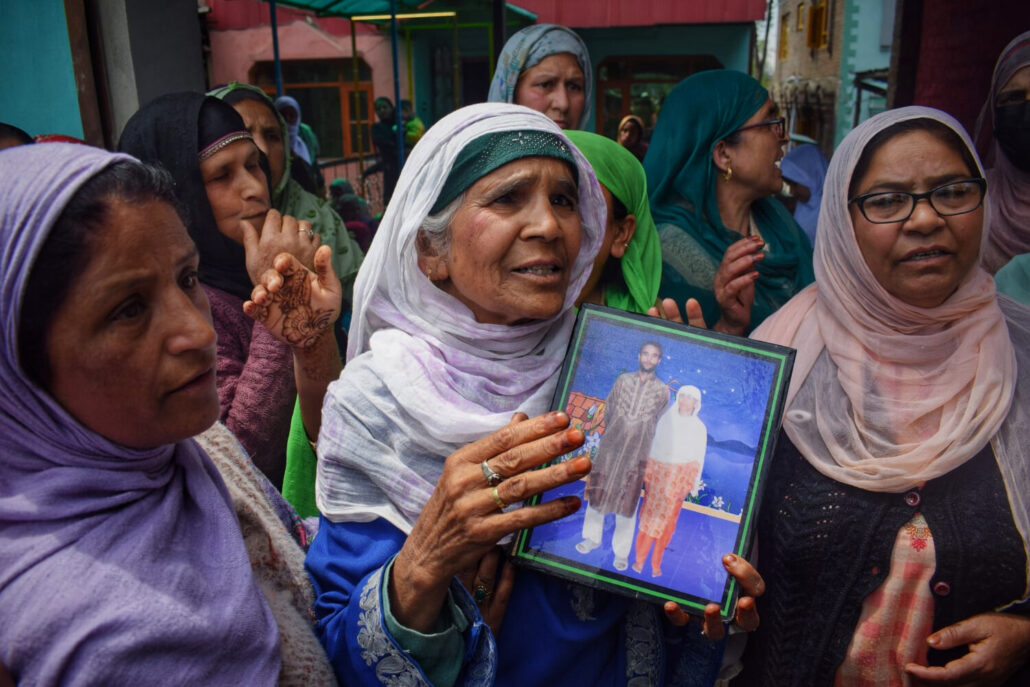
His mother, Saja Begum, returns to the riverbank every morning, clutching a faded photo of her son.
“This river took my son and never gave him back,” she murmurs. “I still talk to it. I still beg it. I just want his body. I want a place to mourn.”
Showkat had been escorting his son, Haziq, to school that day. Witnesses recall him trying to calm panicked passengers and hold on to his child as the boat began to capsize. Haziq survived. His father vanished beneath the current.
“He was a hero in the 2014 floods too. He saved people then,” says his wife, Parveena. “But when it was his turn, nobody came for him. Just a few days of search, and they gave up.”
Today, school uniforms and flowers are laid on the riverbank in memory of the nine children who had boarded the boat. Survivors and families of the victims gathered quietly, some lighting candles, others standing in silence.
“I saw my friends slip away in the water,” says Areeba, 11, one of the survivors. “I don’t like going near the river anymore.”
The tragedy sparked widespread outrage. The Gandabal bridge, which had been under construction for over a decade, became the center of attention. Promises were made. Accountability was demanded.
Twelve months later, the bridge is complete—steel and concrete spanning the Jhelum where the boat once drifted.
“It stands now, but at what cost?” asks Mohammad Ayub, a relative of another victim. “Six lives for one bridge. Is that the price we had to pay for attention?”
For many residents, the bridge is not just a piece of infrastructure—it’s a symbol of failure and delayed justice.
“Every time I cross it, I hear the screams. I see that day,” says Firdousa’s brother, Imtiyaz. “We should’ve never needed boats in the first place.”
No public memorial exists yet. No annual observance by the government. Just families holding onto memory and loss, like Saja Begum, who still looks for her son in the Jhelum’s silence.
“Grief doesn’t fade when there’s no body,” she says. “I talk to the river like he’s still in there. And maybe he is.”
In a valley shaped by conflict and resilience, the Jhelum has long been a witness to tragedy. For Gandabal, the water still holds what the earth has refused to return.


- News Deskhttps://thekashmiriyat.co.uk/author/kashmiriyat/

- News Deskhttps://thekashmiriyat.co.uk/author/kashmiriyat/

- News Deskhttps://thekashmiriyat.co.uk/author/kashmiriyat/
- News Deskhttps://thekashmiriyat.co.uk/author/kashmiriyat/

