

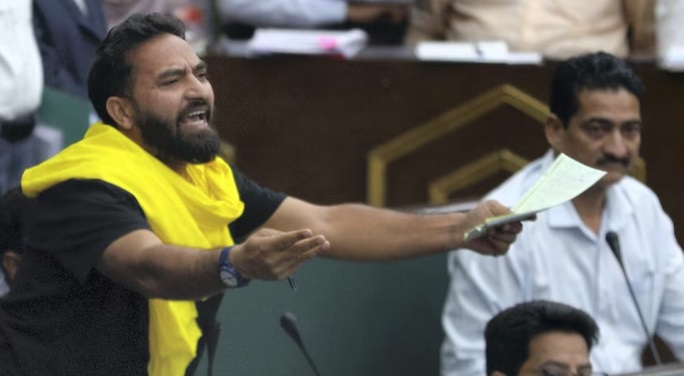
In recent days, the detention of Aam Aadmi Party legislator Mehraj Malik under the Public Safety Act has drawn wide attention from across India. The detention is more than a legal or administrative event. It is a prism through which one can study the contradictions of power in Jammu Kashmir. Malik’s confrontation with bureaucracy, his abrasive tone, and his political style have been cast as the problem. But the real discomfort lies elsewhere: Malik unsettles the established relationship between power and privilege. He represents, in a literal and symbolic sense, the poor.
Critics often describe Malik as harsh, unrefined, even combative. But here arises a question: is the language of the poor to be judged by the standards of the privileged? To demand that a man stripped of subsidised gas, forced into prepaid electricity, and denied rations speak politely is to demand silence in another form. Civility, in such circumstances, is the rhetoric of those who have the luxury of comfort. For the poor, plain truth often comes wrapped in urgency, in anger, and in rawness.
Among the many who rallied in protest after Malik’s detention was a 63-year-old shopkeeper from Bhalessa, a man who lives hand-to-mouth. Standing amid the crowd, he spoke not of politics in the abstract but of survival. We survive on what little we earn each day. When ration is cut, when hospitals fail, when subsidies vanish, it is not a policy decision for us—it is hunger. Malik may speak harshly, but he speaks for us. If they silence him, they silence us,” he said.
The man had shut his modest shop for the second day, knowing well that each day of closure meant a day of hunger for his family. Yet, he shrugged off that fear. “I can survive hungry,” he said, “but someone who spoke for us needs us now. If we do not stand for him, then we have lost more than food, we have lost our dignity.”
There was something profoundly moving in his choice. It was not an act of political theatre but of sacrifice, a quiet declaration that democracy is worth more than the day’s bread. In the small act of shutting a shop, he revealed the larger truth of representation: that it is sustained not by lofty manifestos, but by the willingness of the poor to risk their already fragile survival for the one who dares to speak their name.
This shopkeeper’s presence in Doda, shoulder to shoulder with hundreds of others, is a reminder that the poor are not passive recipients of politics; they are its heartbeat. His hunger becomes political speech, his silence of work becomes louder than the slogans. In his choice to protest rather than sell, he embodies what Antonio Gramsci described as the “optimism of the will”, the courage to act despite despair.
Chronology of Events: Mehraj Malik’s Journey
In 2020, Mehraj Malik entered the political fray by winning a seat in the District Development Council (DDC) from Kahara, Doda, as an independent candidate, signalling his early rapport with grassroots voters.
Years later, Mehraj Malik stunned political observers by winning the Doda Assembly seat as Aam Aadmi Party’s first MLA in Jammu Kashmir. Most had expected the BJP to easily retain the constituency, but Malik defeated their candidate by over 4,500 votes. His win was described as a rare breach into a region long dominated by mainstream parties.
Soon after entering the assembly, Malik’s presence was felt. He openly accused BJP leaders of awarding contracts to their own aides, questioning what he called a “culture of favoritism.” He also spoke out against the rise of liquor outlets in Jammu region an Chenab valley, which he argued targeted vulnerable communities. His straightforward, sometimes brash, style drew strong reactions from colleagues but cemented his image as someone unafraid of confrontation.
Post-election, Malik positioned himself as a vocal critic of entrenched power. He publicly accused the BJP of awarding contracts to its associates and opposed the proliferation of liquor outlets in Doda. Meanwhile, his fiery remarks, such as referencing specific religious groups, triggered assembly backlash. “The political elites in Jammu Kashmir are comfortable with ribbon-cuttings and staged celebrations,” Malik said in one of his interventions. “But when someone speaks about ration, roads, or hospitals, they feel threatened. Your comfort is not our reality.”
In April 2025, Malik had already taken aim at the administration during a livestream, criticising the detention of a local under the Public Safety Act. He said, “A common man can’t even raise his voice against government failures now,” Critiquing the photo op politics in the region, he said, “Only inaugurations and ribbon cuttings will not make your image positive.”
These words positioned him as one of the rare legislators willing to speak publicly against what he considered arbitrary governance.
In May 2025, Malik was booked in an FIR for allegedly threatening and defaming a woman doctor, Dr. Madhu Chib, head of the Gynaecology & Obstetrics department at GMC Doda. The FIR included charges of criminal intimidation and insulting modesty. Prior to that, he had taken a strong stand on medical negligence in Doda. He exposed lapses at GMC Doda, particularly the death of a pregnant woman due to absence of senior doctors and subpar care.
His vocal criticism emphasized that the rich could afford care, but the poor were left to suffer. “The rich can afford private hospitals, and even in government hospitals they receive proper care. But who will take care of the poor?” he asked in a live video.
In Early September, A major flashpoint emerged over the relocation of the Ayushman Arogya Mandir/Health and Wellness Centre from Kencha village in Thathri block. Malik asserted that the DC and administration were favouring vested interests by shifting the centre into a private individual’s residence. He also highlighted that despite the owner being owed rent (taken on loan), the administration refused to pay.
Officials countered that they moved the centre due to safety issues and regulatory compliance.
On September 5, Malik, with supporters, allegedly removed equipment, medicines, and records, prompting a police FIR under portions of the Bharatiya Nyaya Sanhita for trespass, theft, and obstruction.
On September 8, 2025, Malik said he was not allowed to move into the areas of his constituency, “There are many areas in my constituency which are without road connectivity, ration and without shelter after their homes were damaged but I am being detained here. I have no right to speak or protest for my people… some people are trying to give communal colour to my objections against the deputy commissioner. He (DC) had booked six of my colleagues in a fake case and is oppressing the poor.”
On September 9, became the first sitting MLA in Jammu Kashmir to be detained under the Public Safety Act. Authorities accused him of disturbing public order after his repeated clashes with officials.
Representation Beyond the Elite
Unlike many politicians who stage their lives in hotels, conference halls, and manicured lawns, Malik’s public image is drawn from the homes of the poor, from villages and broken roads. His videos show him receiving blessings from aged farmers, consoling patients, or standing with small shopkeepers. This proximity is not accidental, it is political. He would remind viewers, on his social media, that the rich could afford private hospitals and connections, but “who will take care of the poor?” In almost every controversy he was embroiled in, the poor remained his first reference point. Locals from Bhalessa, his home village, recall how he often donated his salary to needy families and made a point to buy supplies from small shopkeepers.
Classical political theory often reduces representation to mediation by elites, those with lineage or resources. Malik breaks this frame. His repeated focus on hospital negligence, “The rich can afford private hospitals, even at government hospitals they get care, but who will take care of the poor?”, is not simply a populist line. It is the articulation of what “subaltern demand,” one that unsettles the dominant bloc and insists that democracy must extend to those long excluded from its real benefits.
Sociologist Pierre Bourdieu used the term “symbolic violence” to describe the quiet ways in which power naturalises inequality. In India’s hospitals, education system, government offices, this is visible daily: two systems of care, one for the rich and one for everyone else, as Rahul Gandhi puts it. Malik’s politics exposes this violence. His bluntness is not personal temperament alone; it is structural, born of his alignment with those for whom bureaucracy is not paperwork but humiliation.
Yet no politician is without contradiction. Malik’s confrontational style risks narrowing dialogue, and governance does require negotiation. Here his critics find some ground. But to insist that he dilute his anger is to insist that he abandon the very quality that makes him a true representative of the poor. In him, we see a paradox: he is both an insider, a legislator of the Assembly, and an outsider, a critic of the very elite consensus that Assembly represents.
The protests that followed Malik’s detention in Doda, and the solidarity shown in Chenab valley and Pir Panjal, underline one truth: his struggle is not merely his own. It is a struggle over who gets to speak in democracy, and in what tone. Can politics belong to the poor, or must it always be mediated, softened, and disciplined by the privileged?
Here one recalls B.R. Ambedkar’s warning: political democracy without social and economic democracy is fragile, even hollow. Malik’s case makes this warning tangible. His politics insists that democracy cannot be reduced to ritual elections while ignoring hunger, medical neglect, and daily indignities.
Mehraj Malik is not flawless. He is, however, necessary. His fight is not about language but about class, not about civility but about survival. To frame him as merely abrasive is to miss the point: he embodies the unfinished struggle of democracy. His voice, however raw, asks the one question that matters: can democracy truly belong to the poor, or will it always remain the privilege of the few?
If democracy means anything, it must mean the right to speak, even harshly, on behalf of those for whom silence is the only other option.

- News Deskhttps://thekashmiriyat.co.uk/author/kashmiriyat/

- News Deskhttps://thekashmiriyat.co.uk/author/kashmiriyat/

- News Deskhttps://thekashmiriyat.co.uk/author/kashmiriyat/
- News Deskhttps://thekashmiriyat.co.uk/author/kashmiriyat/

