
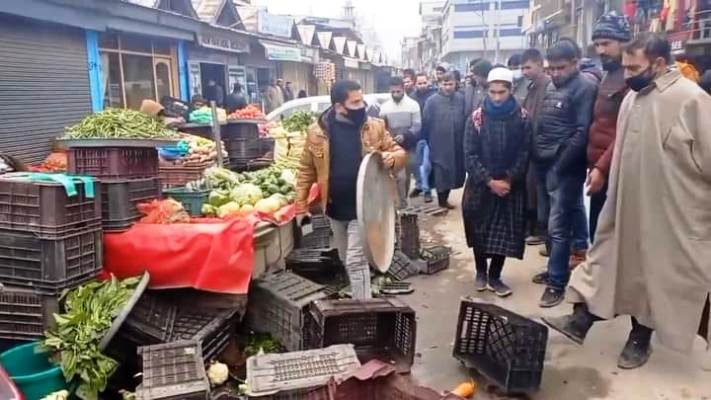
Across India, and more acutely in Kashmir, the lived realities of poor street vendors are being erased. Bulldozed, beaten, branded encroachers. Despite their foundational role in the local economy, they are criminalized in the name of urban order. Towns that grew around them are now trying to grow without them. In the official narratives, vendors do not build the city, they block it.
The government says vendors clog the roads, block ambulances. Yet it is never the VIP convoys, the luxury SUVs with tinted windows, the illegal parking of government vehicles, it is always the poor. The rhetoric is tired but effective: “beautification,” “development,” “public good.” Their homes and stalls are wiped out, and a press note is mailed out. Often, the headlines are already ready.
In urban spaces across Kashmir, demolition drives are conducted under this very logic. Videos emerge showing municipal officers mocking vendors while tearing down their carts. One such video captured an official laughing while breaking a shop, as the vendor begged to be spared. There was no elected representative to intervene, only state power in uniform, unchecked and unaccountable.
“That’s why we need elected representatives,” a vendor told me, voice flat from exhaustion. “When the officer broke our shop, he was laughing. An MLA, even if he orders breaking our house, he would not laugh.” That laugh, cruel, detached, tells you everything about how power without accountability behaves. Democracy doesn’t always save you. But authoritarianism never even sees you.
This pattern of class violence is not new, but its frequency and scale are intensifying. In 2021, the Jammu Kashmir National Conference publicly condemned the “high-handed approach” of authorities during a similar drive in Sopore. Masarat Kar, the Municipal Chairperson herself, was reportedly physically mistreated while protesting peacefully against the demolition of hawker stalls. The party spokesperson demanded that action be taken against those responsible for humiliating a public representative. The incident came and went, like many others. But for vendors, every demolition is not a headline, it is a hunger.
Sopore, originally known as Suyyapura, was founded in 880 CE by the engineer Suyya during King Avantivarman’s reign. The town was born from a hydraulic vision — flood control, land reclamation, and trade. Long before “smart cities,” bylaws, or administrative maps, Sopore’s identity was built around open marketplaces. By the early 20th century, Bada Bazar and Chota Bazar had emerged as vital trading hubs. Later, as the town expanded, Noor Bagh, New Colony, Badam Bagh, Bus Stand Market, so did the space for informal traders. Street vending was not a disorder; it was the default mode of commerce.
The same story unfolds across Kashmir. From Handwara to Kulgam, Baramulla to Bijbehara, towns grew with the poor, not despite them. These vendors weren’t invaders of space, they were its earliest custodians. When nobody could afford shops, they carried business in baskets and pushcarts. When no formal economy existed, they were the economy.
Today, those same bodies are being removed for making the city “unhygienic.” The city, we are told, must be cleaned, of whom?
Beneath the logic of urban order lies a colonial-modernist impulse: people are valued for what they own, not for what they endure. Capital defines dignity. Presence is permitted only if it’s profitable. This is the same logic that once deemed Adivasis, tribals, or pastoralists as “unproductive” or “uncivilized” for refusing to fit into state-approved molds. Today, street vendors are treated as visual and spatial pollution.
The state calls this “planning.” In reality, it is displacement by design, a slow, quiet violence. Structural, philosophical, and deeply classed.
What makes this worse is the complicity of journalism. Media, once a mirror to power, has become its shadow. Instead of asking why these demolitions occur, most journalists repeat bureaucratic terms like “illegal encroachment,” “beautification,” or “streamlining traffic.” They do not speak to those whose livelihoods are destroyed. Their cameras pan across the broken stalls, but never the broken people. Their voices remain absent.
Worse still, the journalists who dare to speak, the so-called “Facebook journalists,” mocked by their more “professional” peers, are often the only ones capturing raw, unfiltered voices from the margins. With cracked phone screens and unstable livestreams, they document what the mainstream refuses to see. For that, they are trolled, mocked, sometimes even arrested. Why does a journalist avoid a grieving vendor? Why does a story end at a government quote? Why does a newspaper read like a press release?
It is because the cities are not just being rebuilt with new cement, but with new hierarchies. Cities are not failing. They are working exactly as designed, for the rich. Wealth now decides who gets space, who gets seen, who gets saved. Who gets bulldozed, and who bulldozes.
The aspirational class, which includes journalists, cheering on these “cleansing drives,” believes this violence will never reach them. But the logic of dispossession, once normalized, expands its targets. The rules of this game are clear: fitness means capital. It is not about survival of the fittest, but about survival of the richest. This is not development. It is erasure with a smile.
It is as sociologist Zygmunt Bauman wrote, “the production of human waste, or more correctly, wasted humans is an inevitable outcome of modernization. This is a violent world, not by war or weapon, but by design. The logic of capital has no mercy.
In Kashmir, the waste is not an accident. It is a policy. A worldview. A purge.
Yes, congestion may be a problem. It may choke the roads to hospitals and schools and to the heart of the town itself. But to deal with that problem by erasing the poor is not only cruel, it is structurally violent, and has been recognised as such even by previous governments, which suspended officials for unleashing class-rooted brutality under the garb of order. We must be honest about what this violence is: not just administrative excess, but a deeply embedded logic of power that punishes the most vulnerable for the sins of a broken system.
What is required is not bulldozers, but imagination. A rethinking of what expansion means, of how cities grow and for whom. That cannot happen without bringing actual stakeholders on board, the workers, the street vendors, the informal economy that sustains the city but is now being pushed out of it. No plan that excludes them is democratic. And no order built on their erasure can last.
There are alternatives. We can build vending zones that are not buried in urban outskirts where no footfall exists. We can develop alternative traffic routes, intelligent zoning, and public transport options that do not demand a choice between livelihoods and access to emergency care. This is not a binary of ambulances versus bread, it is a matter of justice, vision, and will. No matter how sanitised it may look, a city that displaces its poor is a city that eats itself.
In the long run, this violence will not spare even the aspirational class cheering it on. As thinkers like Herbert Spencer once echoed in their twisted version of “survival of the fittest,” societies organise themselves so that only the most powerful survive, but history tells us the bill for such cruelty eventually reaches everyone. What we are watching is not development. It is social decay wearing the face of urban order. And if left unchallenged, it will haunt us all.
If our cities cannot accommodate their poorest with dignity, they do not deserve to be called cities. The city that cannot make room for the poor, the one who built it has no future, only expansion without meaning. Every time a cart is smashed in the name of “streamlining,” a truth is also smashed: that public space belongs to everyone, not just to those with access, money, or the right contacts.
That this still needs to be said, in 2025, is not just a failure of governance. It is a failure of imagination. Of policy. And most painfully, of journalism.

- News Deskhttps://thekashmiriyat.co.uk/author/kashmiriyat/

- News Deskhttps://thekashmiriyat.co.uk/author/kashmiriyat/

- News Deskhttps://thekashmiriyat.co.uk/author/kashmiriyat/
- News Deskhttps://thekashmiriyat.co.uk/author/kashmiriyat/
