

Faheem Ahmad
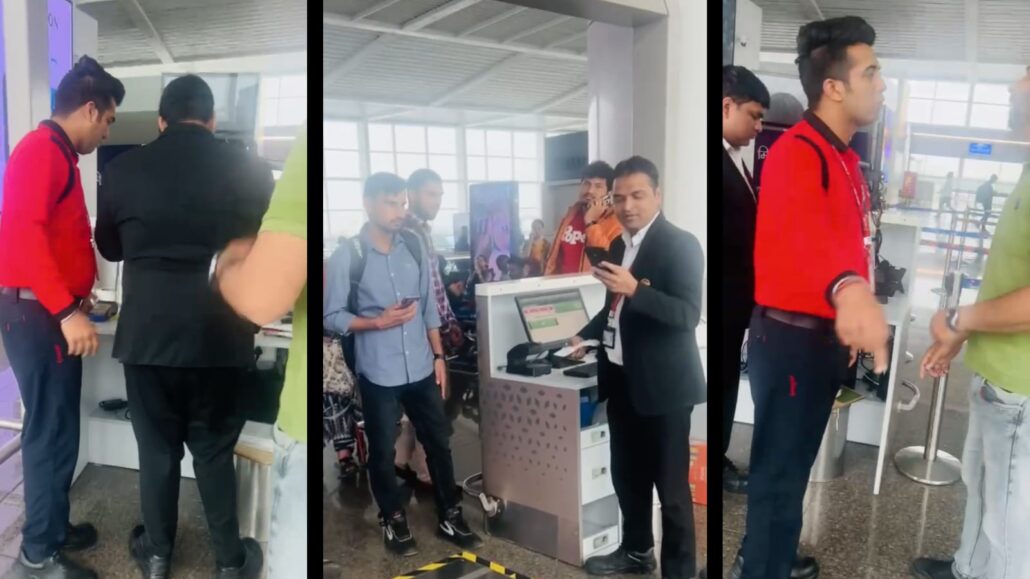
A Kashmiri medical student has accused SpiceJet staff at Delhi’s Indira Gandhi International (IGI) Airport of harassment, verbal abuse, and communal profiling during a flight boarding process on April 26, also highlighting serious lapses in professional conduct by the airline’s ground crew.
Sana (name changed), a postgraduate student pursuing an MD at the National Institute of Unani Medicine in Bengaluru, was traveling with her sister when the incident occurred; the two had been in Delhi for shopping before boarding a flight back to Srinagar.
“Since I travel frequently, I know that student ticket holders are allowed to carry a separate laptop bag. My sister had a student ticket, yet the staff stopped her and began misbehaving,” Sana told The Kashmiriyat.
She added that a boarding staff member grew hostile toward them, allegedly motivated by their Kashmiri identity.
“Our bags were scanned multiple times, yet we were still wrongfully accused. Despite undergoing thorough security checks, we were harassed and labeled as terrorists simply because of our Kashmiri identity. This isn’t just about Islamophobia or anti-Kashmiri sentiment—it’s a glaring example of unprofessionalism at its worst. We followed every protocol, yet we were treated with hostility and suspicion, with no justification whatsoever,” Sana said in conversation with The Kashmiriyat over the phone.
The situation escalated when the sisters were threatened with being barred from boarding. They were also allegedly forced to pay an unexplained additional charge of Rs. 3,900. “When my sister and a few fellow Kashmiri passengers questioned them, one staff member told us, ‘We know what you carry in your bags. You are the reason for what happened in Pahalgam,” she added.
This chilling remark referred to the barbaric Pahalgam attack, which claimed the lives of 26 civilians. Though authorities have initiated action, a wave of retributive hate has gripped several cities, targeting innocent Kashmiri students, workers, and travellers across India.
In Kharar, Punjab, a female Kashmiri student alleged that she and her friend were abused and harassed by locals on April 24, prompting the Punjab State Women’s Commission to take notice of the incident.
In Dehradun, members of the Hindu Raksha Dal, a far-right Hindutva organization, issued threats warning Kashmiri Muslims to leave the area or face unspecified consequences.
Additionally, videos circulating on social media depict frightened Kashmiris and instances of their physical assault in nearly half a dozen Indian cities, leading to widespread concern and calls for ensuring the safety of Kashmiris across the country.
These incidents suggest that Sana’s ordeal is far from an isolated case—it is part of a growing and deeply concerning pattern of communal targeting, racial profiling, and professional negligence that continues to endanger the lives and dignity of Kashmiris living or traveling outside the Valley.
Critiques have drawn attention to how sections of Indian media and mainstream cinema have played a role in reinforcing stereotypes and fueling hostility against Kashmiris and Muslims.
Films like The Kashmir Files have sparked intense controversy for their depiction of Kashmiri Muslims, with many critics alleging that such portrayals reduce a complex historical tragedy into a communal narrative. “The fictional movie, which dramatizes the exodus of Kashmiri Pandits, inflamed anti-Kashmiri Muslim sentiment, especially in the way it was received by certain political groups and audiences who used the movie as justification for hate speech against Muslims,” said Shivagni Sharma, a political science professor from Delhi.
Another recent film, The Kerala Story, has also faced backlash for propagating the conspiracy theory of “love jihad,” further normalizing Islamophobic tropes in popular discourse.
These films, endorsed and promoted by political leaders, often receive widespread coverage on mainstream news channels, many of which are also accused of amplifying communal rhetoric under the guise of nationalism.
Analysts have observed that these cinematic and media narratives can shape public perception, create moral panic, and indirectly sanction discrimination and hostility toward Kashmiris and other minority communities. “These portrayals are particularly damaging in a climate where Kashmiris frequently report experiences of profiling, surveillance, and abuse while traveling or working outside their home state,” Shivagi told The Kashmiriyat.
She argued that the normalization of “communal bias in media and cinema” not only desensitizes the public to hate but also emboldens individuals and institutions to act on these prejudices without fear of accountability.
During the altercation on April 26 at Delhi Airport, a SpiceJet employee, whom Sana identified as Nikhil Sharma, allegedly began recording the sisters without their consent. “When I objected, he said, ‘Tum kya kar logi? Mera naam Nikhil hai,’” Sana recalled.
The experience left Sana shaken. She suffered a panic attack mid-flight due to the mental distress. “Half of Kashmir’s population suffers from some form of psychological trauma. This just adds to it,” she said. Upon arrival in Srinagar, Sana filed a formal complaint at the local SpiceJet counter and was directed to email the company.
As of now, she says she has received no response.
“I am a Kashmiri, and it is not a sin,” Sana said. “The entire SpiceJet staff involved must apologise publicly. Airports are supposed to be the safest spaces. If this is how we’re treated there, what’s left?”

Speaking to The Kashmiriyat, Sana expressed concern about the impact of such incidents on the mental well-being and mobility of Kashmiris, especially students and professionals like herself and her sister, who often travel outside the Valley. “She is scared to leave now. And I’m afraid, too—I’m supposed to join Uttaranchal University as an assistant professor. But what kind of treatment awaits us?”
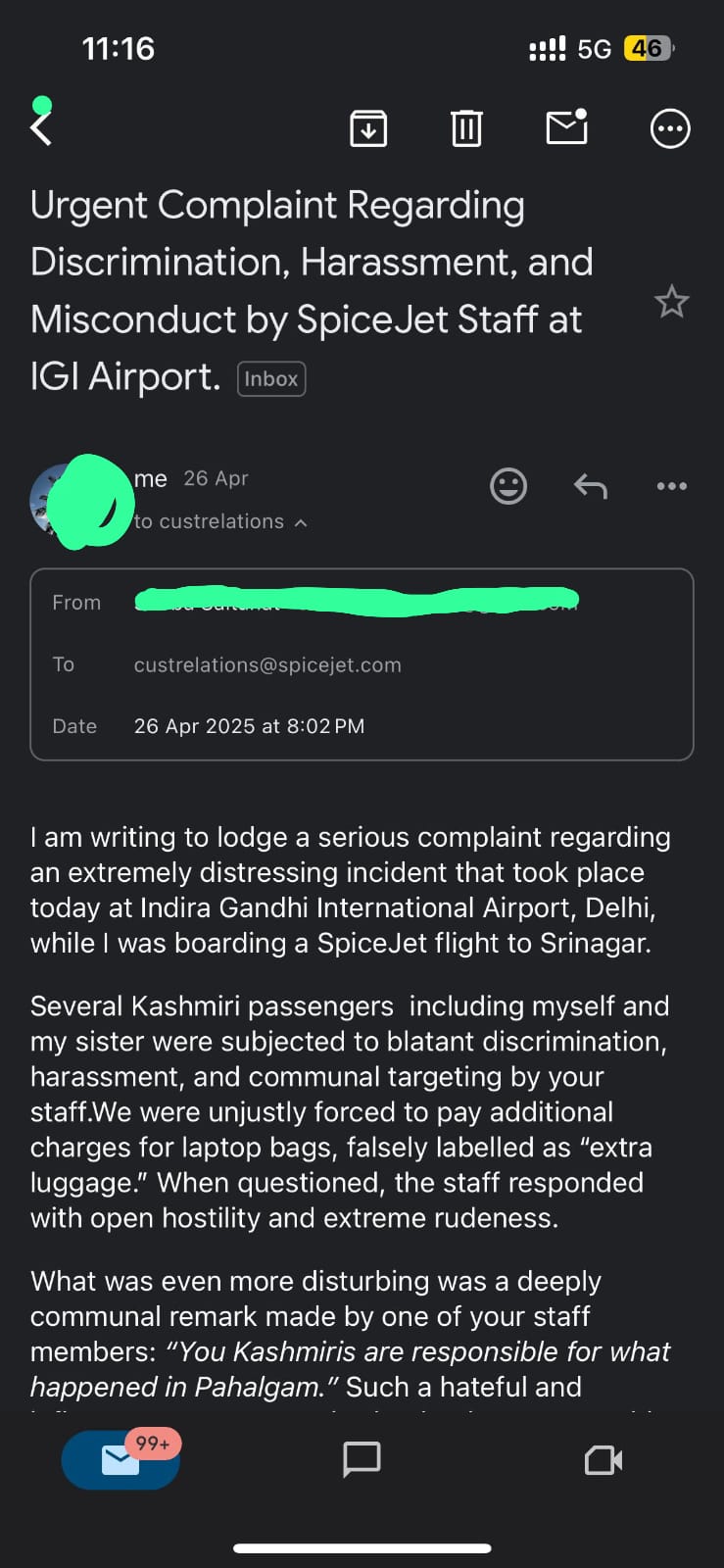
Sana has written an email to SpiceJet expressing concern over the unprofessional behavior of the staff of the private operator. In her Email, Sana reported that one of the staff members made a communal remark, directly quoting them as saying, “You Kashmiris are responsible for what happened in Pahalgam.”
She, in the email, characterized this statement as hateful and inflammatory, indicating the seriousness of the discriminatory behavior and the emotional distress it caused.
SpiceJet has yet to respond to the email or issue a public statement on the matter.

- News Deskhttps://thekashmiriyat.co.uk/author/kashmiriyat/

- News Deskhttps://thekashmiriyat.co.uk/author/kashmiriyat/

- News Deskhttps://thekashmiriyat.co.uk/author/kashmiriyat/
- News Deskhttps://thekashmiriyat.co.uk/author/kashmiriyat/

