

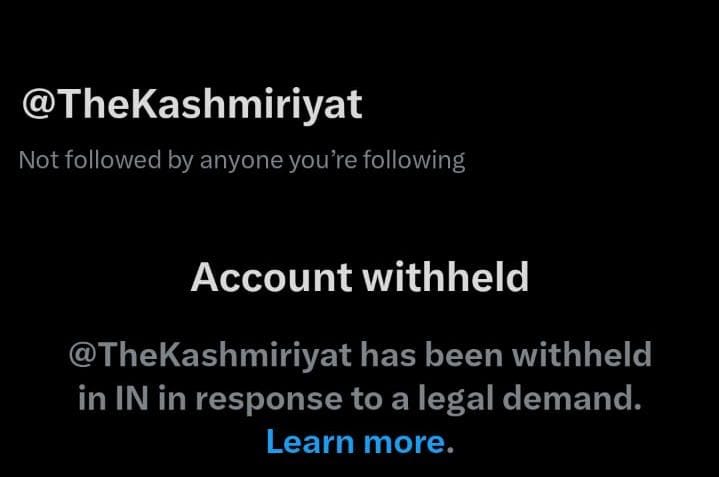
“Where do we read the news now,” said an X user, after he found that the Twitter (X) handle of The Kashmiriyat had been withheld in India on Thursday, amid the India-Pakistan tensions.
In the midst of escalating tensions between India and Pakistan, the Indian government has ordered an blocking access to dozens of independent media outlets and journalists on X (formerly Twitter).
The clampdown has raised alarm bells across the journalistic fraternity and civil society, who see the move as a targeted attempt to silence voices that are highlighting the ground situation.
According to X, 8000 handles were blocked in compliance with executive orders issued by the Indian government, which directed the company to withhold access in India to numerous accounts of journalists, news organizations, and activists
“We disagree with these actions. Blocking entire accounts is not only unnecessary, it amounts to censorship… and is contrary to the fundamental right of free speech,” X said in a public statement. While the legal orders are not public due to governmental restrictions, X said it is exploring legal avenues and encouraged users to seek judicial review.
Among the withheld accounts are:
• @TheKashmiriyat
• @MaktoobMedia
• @FreePressK
• @iArpitSpeaks
• @iamharunkhan
• @AnuradhaBhasin_
• @Muslim (a US-based account)
The government has also blocked access to the website of a prominent news outlet, The Wire, evoking widespread protests from cross sections of society.
The move has sparked widespread condemnation among journalists, civil society members, with citizens pointing to a selective digital purge aimed at silencing dissenting voices, especially those from conflict zones and marginalized communities.
Aditya Menon, a prominent journalist from India, criticising the ban wrote, “The hypocrisy is clear—while media platforms spreading lies face no action, independent outlets are silenced.”
Condemning the ban on The Kashmiriayt’s X handle, Sarayu Pani, an Indian journalist, wrote, “Honestly what message does the government think it’s sending here??”
Prominent student organisations have also condemned the ban. All India Students Association issued a public statement condemning the ban.
They said, “Reporting on the loss of civilian life and consequences of the tense military situation between India and Pakistan cannot amount to a crime. Such massive crackdown on press freedom and freedom of expression is unwarranted and cannot be justified. In this tense military situation between two nations, the people of Kashmir who are most vulnerable in this escalation and the common people of India have a right to factual and proper information about the developments as well as the massive consequences that this military escalation is already extracting from us. On the other hand Corporate Media Houses like ABP Live, Republic TV and others have been constantly spreading misinformation. Most recently, the Godi media falsely labeled Qari Mohammad Iqbal as a terrorist who the District Police of Poonch had to later clarify was in fact was a teacher from Poonch who was killed in Pakistani shelling. These Godi media houses enjoy complete impunity as they propagate false.”
Anusha Ravi Sood, a reputed journalist reflecting on the ban said, “TV channels that are peddling misinformation and whipping up hysteria without common sense are not even questioned.”
Kashmiri journalists also expressed their outrage over the ban and sought an instant restoration of the X handle of The Kashmiriyat.
Murtaza Bilal echoed this sentiment: “The silencing of @TheKashmiriyat, a small independent outlet led by @QaziShibli, speaks volumes. While prime-time hate factories run unchecked, those reporting ground realities are muzzled. This isn’t law—it’s selective suppression.”
Muhammad Waseem said, “Godi media is being given full freedom to spread misinformation while our prominent journalists’ accounts are being withheld—they might share the truth.”
Anusha Ravi Sood tweeted: “TV channels peddling hysteria face no action, while @MaktoobMedia, which was fact-checking them, is blocked. This is deeply troubling.” Ayush Tiwari added that the government has mechanisms like the Cable TV Networks Act to regulate misinformation on television but uses none of them—reserving harsh action instead for independent digital outlets.
Shabir Ali, a journalist from Srinagar noted: “Truthful reporting deserves protection, not punishment. The withholding of @TheKashmiriyat is a concerning setback to press freedom.”
Even international media observers and public intellectuals weighed in. Rana Ayyub questioned, “Freedom of the press, anyone?”
The condemnation also spilled over to Instagram.
Asking people to support The Kashmiriyat, one Instagram user @livesinthoughtbubbles wrote, “If you need trusted sources at the time of media blackouts and ai generated images and state generated propoganda and misinformation campaigns, here are the handles I follow, @TheKashmiriyat.
“These are journalistic sources reporting with direct access to ground – either personally or via communities in Kashmir that they are in contact with via their work even before this latest escalation. If you have other trusted direct sources that you want others to know about – feel free to DM,” the instagram user added.
Things are escalating so fast – i’m reminding myself to not be reactionary and want to invite you to do the same. Normalise taking your time to understand what’s going on.
She added, “It helps me keep panic and fear at bay”.
Another Instagram user Shaala posted: “Blocking all independent news media because they want everyone to consume only ‘their version’ of this war on terror through their mainstream media, war propaganda, and misinformation circus.”
Social media users from Kashmir also expressed their anger and confusion over the blocking of The Kashmiriyat on X.
“I don’t know what this is. Where do we see the news now?”, a Twitter (X user) wrote expressing confusion over the banning of the X-handle of The Kashmiriyat on the platform in India on May 8 (Thursday.) Another added, “We’re being herded to mainstream TV. I’d rather not watch the news at all.”
The Kashmiriyat responded to the block, by issuing a public statement. “We just tried to access our X (Twitter) handle, only to find that our account has been withheld in India. It’s hard to put into words. This feels like an erasure of years of work, of the countless hours we poured into honest, often difficult journalism. It’s not just a platform that’s disappeared; it’s a part of the journey of how Kashmiri journalism evolved these years. To be silenced without warning hurts, deeply. If our work has meant something to you, we ask you to help keep it alive—by sharing links to our stories on your profiles, timelines, and circles. Let our voice travel, even if it’s been blocked.”
Another prominent X user, Hussain Haidry, responding to the ban on The Kashmiriyat wrote: “Journalistic voices of Kashmiris and Indian Muslims seem to be getting silenced. In sync with propaganda media. Don’t want their talk, don’t want their dead.”
Some users were blunt. Anish posted, “Expose the fash state’s lies, and they’ll come for your voice. Where are the liberals now, after cheerleading for the State?” Saumya Kalia urged support for Maktoob, The Kashmiriyat, and Alt News, calling them “our only hope for truth and restraint.”
As the government continues to remain silent on the specific reasons behind the bans, the scale of the action—targeting alternative voices during a period of heightened conflict—has renewed fears over India’s shrinking democratic space, particularly for media operating from Kashmir and Muslim communities nationwide.
Advitya Pal pointed out that Maktoob, Kashmiriyat, FreePressK, and even US-based @Muslim were among the accounts withheld under sweeping executive orders. Rushda Fathima Khan stated: “This is not just censorship—it’s an attack on independent journalism. This should concern us all.”
“The Wire, Maktoob, The Kashmiriyat, Free Press Kashmir’s and other media accounts are being blocked by the government. Why is access to information and press freedom being restricted in such turbulent times?” Clifton D’Rozario of CPI(ML) wrote.

- News Deskhttps://thekashmiriyat.co.uk/author/kashmiriyat/

- News Deskhttps://thekashmiriyat.co.uk/author/kashmiriyat/

- News Deskhttps://thekashmiriyat.co.uk/author/kashmiriyat/
- News Deskhttps://thekashmiriyat.co.uk/author/kashmiriyat/

