


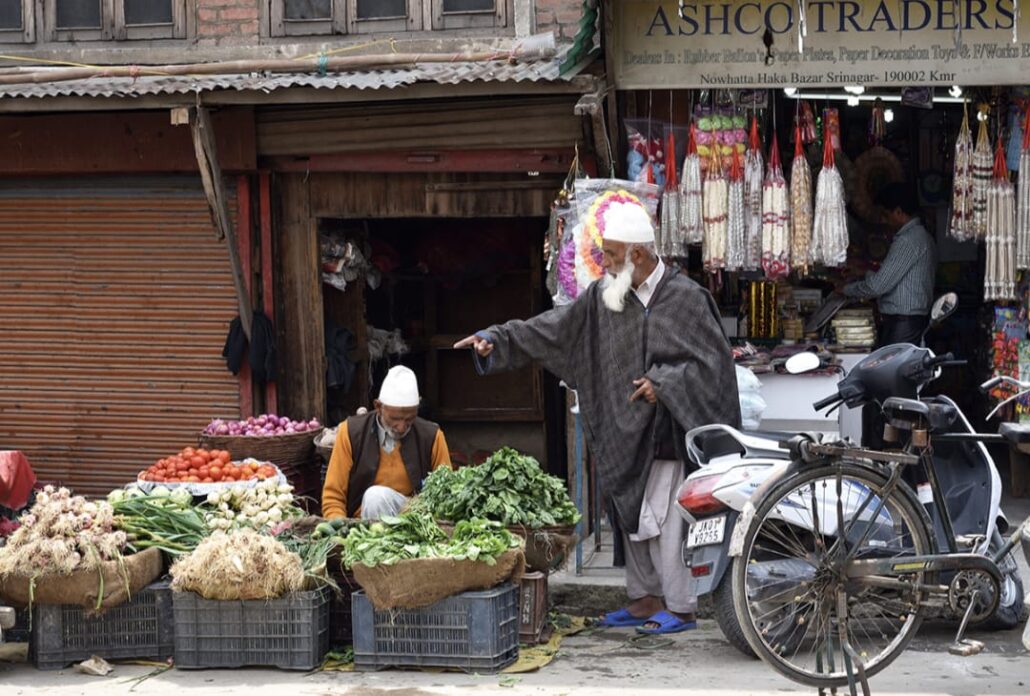
In Kashmir, the street vendor remains a foundational yet criminalised figure.
From the lanes of Srinagar to the congested alleys of Anantnag, these workers—some of the Valley’s earliest traders—helped shape its market economy long before multi-storey complexes and branded storefronts redefined what commerce looked like.
But with urban transformation came selective erasure. Today, many of those who laid the first stones of Kashmir’s trading culture find themselves without a legal place to stand.
Street vendors in Kashmir exist in a legal vacuum. Despite contributing to the region’s informal economy in vital ways—through food vending, clothing sales, mobile repairs, or vegetable carts—there exists no comprehensive policy or registration mechanism to protect their rights.
The Street Vendors (Protection of Livelihood and Regulation of Street Vending) Act, 2014, a central law enacted to safeguard vendors across India, has largely remained unimplemented in the region. No town vending committees. No surveys. No demarcated vending zones. Without identification or registration, their status remains that of encroachers—by default, not by design.
What this legal invisibility facilitates is routine dispossession. In the name of beautification, anti-encroachment drives, and “decongestion,” vendors are frequently evicted with little or no notice.
Bulldozers arrive before due process does. These demolition drives, often carried out with visible force and zero rehabilitation plans, are not aberrations. They are the policy in action—unspoken but sustained.
Social media has further weaponised public sentiment against them. Videos of vendors being manhandled, their carts overturned, their goods scattered, routinely circulate—sometimes posted by officials themselves. Rather than prompting outrage, such posts often find support in the comment sections, where vendors are portrayed as urban clutter, illegals, outsiders—even in their own land.
The irony is biting. These vendors, who often survive on daily earnings, pay more in indirect taxes—on every purchase, every transit, every utility—than many among the salaried middle and upper classes who demand their removal. And while the state’s wealthiest enjoy tax breaks, subsidies, and planned infrastructure, the street vendor is offered a lathi and a bulldozer.
Eviction is not a singular event for them; it is a cycle. They return, again and again—not out of ignorance or defiance, but out of necessity. Their fight is not for space alone; it is for survival.
Kashmir’s street vendors, many of whom are second- or third-generation workers, are not just peripheral actors in the city’s economy. They are its scaffolding.
They bring fresh produce, hot meals, basic goods, and affordable services to neighbourhoods that larger enterprises don’t reach. They are self-employed, tax-paying, hardworking citizens. Yet, their existence is treated as a problem to be managed, not a labour force to be protected.
On World Labour Day, their absence from official celebrations and policy documents is telling. The day passes with speeches on the dignity of labour, while the labourer on the street is silenced—first by the state, then by the citizen.
If World Labour Day means anything in Kashmir, it must start by recognising the rights of the street vendor to exist, to work, and to be seen.


- News Deskhttps://thekashmiriyat.co.uk/author/kashmiriyat/
- News Deskhttps://thekashmiriyat.co.uk/author/kashmiriyat/
- News Deskhttps://thekashmiriyat.co.uk/author/kashmiriyat/
- News Deskhttps://thekashmiriyat.co.uk/author/kashmiriyat/


